

Blog: Want to Buy a Home? Do the Math

It is a common misconception that a 20 percent down payment is required to buy a home. Advice to wait and save a large down payment is often based on the theory that the cost of mortgage insurance (MI), which is required when you buy with a smaller down payment, should be avoided. This may not be the best advice and is, in fact, not in line with market trends, considering the median down payment for first-time homebuyers is 7 percent, according to the National Association of Realtors.

Yes, you can qualify for a conventional mortgage with a down payment as small as 3 percent of the purchase price. It is also true that you can reduce your monthly mortgage payment by paying for discount points at closing, but that can be 5 or 10 percent of the purchase price — not 20. And because every buyer’s situation is unique, it’s important to do the math. In today’s market, it could take a family earning the national median income up to 20 years to save 20 percent, according to calculations by U.S. Mortgage Insurers using a methodology developed by the Center for Responsible Lending; a lot can change during that time, in the family’s personal finances and in overall mortgage market trends.

How can buying now save you money later?

Consider you want to purchase a $255,000 home. A 5 percent down payment is $12,750 versus $51,000 in cash for 20 percent down. With a 740 credit score at today’s MI rates, your monthly MI payment would be about $110, which is added to your monthly mortgage payment until MI cancels. MI typically cancels after five years; therefore, you will only have this added cost for a short period of time versus waiting an average of 20 years to save for 20 percent.

With home price appreciation, today’s $255,000 home will likely cost more in the years ahead and this will also have an impact on the necessary down payment and length of time required to save for it. There are other variables in the equation too, such as interest rates. As federal rates rise from their historic lows, so too will the costs associated with financing a mortgage. The savings a borrower might calculate today could be altogether negated by waiting even a few more years. Another factor is that rents are on the rise across the nation, leading to a reduced capacity for many would-be homebuyers to save for larger down payments.

If you decide to buy today with a low down payment mortgage that has private MI, keep in mind that the monthly MI payments are temporary and go away, lowering the monthly payment over time. Again, private MI typically lasts about five years as it can be cancelled once a homeowner builds approximately 20 percent equity in the home through payments or appreciation and automatically terminates for most borrowers once he or she reaches 22 percent equity. Importantly, the insurance premiums on an FHA mortgage — a 100 percent taxpayer-backed government version of mortgage insurance — cannot be cancelled for the vast majority of borrowers.

So, do the math and let the numbers guide you. There are many online mortgage calculators that can help. Check out lowdownpaymentfacts.org to learn more.

Op-Ed: Private insurance plays a critical part in home mortgage ecosystem


By Lindsey Johnson

2/17/19

Housing finance reform remains a priority in Washington. Earlier this month, Senate Banking Committee Chairman Mike Crapo (R-Idaho) released a proposal to reform the government-sponsored enterprises, Fannie Mae and Freddie Mac.

Like many other proposals, including House Financial Services Committee Chairwoman Maxine Waters’ (D-Calif.) HOME Forward draft legislation, Chairman Crapo’s proposal recognizes the important role that private capital — and specifically private mortgage insurance — serves to facilitate homeownership for low down-payment borrowers and protect taxpayers from mortgage credit risk.

The nominee for director of the Federal Housing Finance Agency (FHFA), Mark Calabria, recently appeared before the Senate Banking Committee as part of his confirmation process. He’s an individual who appreciates the benefits that private mortgage insurance extends beyond protecting the government and taxpayers.

Private mortgage insurance remains the longest serving, time-tested way to help low down-payment borrowers qualify for home financing in the conventional market.

Our nation’s mortgage finance system is one that must balance access to credit for consumers while also shielding taxpayers. Fortunately, private mortgage insurance is uniquely and permanently dedicated to serving both objectives through all economic cycles. As such, it should remain a critical piece of any future, reformed system.

Access to affordable, low down-payment mortgages is understandably top-of-mind for many policymakers. While there is an important role for government and taxpayer-backed programs to play in the broader system, any comprehensive reform should first encourage the greater use of private capital that ensures access to affordable low down-payment mortgages in the conventional market.

Fortunately, there is generally bipartisan agreement around this principle. Facilitating this kind of mortgage lending is precisely the purpose of private mortgage insurance, which has helped more than 30 million families secure home loans over the last six decades — many of whom were first-time or middle-income homebuyers.

Last year, more than 1 million homeowners qualified to purchase or refinance their home thanks to private mortgage insurance. Of these homeowners, nearly 60 percent were first-time homebuyers and more than 40 percent had incomes below $75,000.

Congressional leaders and the Trump administration must reform the housing finance system into one that works for all Americans by protecting taxpayers while also ensuring access to affordable mortgage financing.

The Harvard Joint Center for Housing Studies projected that the U.S. would add 13.6 million households between 2015 and 2025, which means affordable low down-payment options must be part of the equation.

Mortgage insurance companies support the government-sponsored enterprises and mortgage lenders in the origination of low- to moderate- income mortgage programs that address affordable housing needs of local communities.

The private mortgage insurance industry stands ready to continue its role as the solution to enable millions of families to achieve homeownership.

A version of this op-ed originally appeared in The Hill on February 17, 2019.

Blog: Mortgage insurance — added cost to homebuying or smart way to get in?

The homebuying process is exciting, but can also seem fraught with added costs, like a home inspection, title insurance and closing costs. And if you can’t afford a full 20 percent down payment on a conventional home loan, then you will most likely pay for private mortgage insurance (MI). Some people consider private MI yet another added cost, but it helps creditworthy middle-income homebuyers qualify for home financing sooner with a low down payment. Is it really an added cost if it saves time and money in the long run?

For most people, low down payment home loan options include conventional loans with private MI and government-backed loans like those offered by the Federal Housing Administration (FHA). While comparable, each of these options has important differences. For example, the minimum down payment for an FHA mortgage is 3.5 percent while it’s only 3 percent on a conventional, privately insured mortgage.

Another key feature of private MI is that it can be canceled when a borrower reaches 20 percent equity in his or her home. Borrowers who purchase a home with private MI can typically cancel it within 5 to 7 years, resulting in their monthly bill going down. Private MI’s cancelability makes it a more affordable option over FHA-backed mortgages, which typically require mortgage insurance premiums for the entirety of the loan term. Both are offered by most mortgage lenders, so it’s smart to ask a loan officer for both options so you can compare and do the math.

The myth that a homebuyer needs 20 percent down to obtain a mortgage is simply not true. Low down payment mortgages are widely available and used every day across the country. In 2018, the National Association of Realtors found that first-time homebuyers typically put down 7 percent, while repeat buyers put down an average of 16 percent. Many homebuyers choose a lower down payment option to preserve some savings for home improvements or save for other goals. The time it could take to save up a 20 percent down payment is significant. On average, it could take up to 20 years to save a full 20 percent, plus closing costs, for a $257,700 house — the national median sales price. With home prices on the rise, the amount of time it takes to save up could only increase. Private MI can mean the difference between getting into the home of your dreams sooner or waiting for years.

For over 60 years, more than 30 million homeowners of all backgrounds have used private MI to successfully buy their homes. In the past year alone, private MI helped more than one million borrowers nationwide purchase or refinance a mortgage. According to a study by U.S. Mortgage Insurers, 56 percent of purchase borrowers were first-time homebuyers and more than 40 percent had incomes below $75,000.

For decades, millions of homeowners and prospective homebuyers have relied on private MI to help them affordably and responsibly purchase their homes — in turn helping them build personal wealth. Today’s historically low mortgage interest rates are a good reason to buy a home now. It is estimated that in 2019, the average rate for a 30-year fixed-rate mortgage will be around 5 percent. Borrowers should take advantage of these historically low mortgage interest rates because experts forecast that primary mortgage rates are on the rise.

Getting a mortgage with private MI and keeping more of your hard-earned money in the bank can be a very smart way to invest in your future. Check out lowdownpaymentfacts.orgto learn more.

Blog: Private Mortgage Insurance Is Helping First-Time Homebuyers Become Homeowners

By Lindsey Johnson

A myth about homeownership that discourages many prospective homeowners is that they need a 20 percent down payment to obtain a home loan. Not true! What many borrowers do not realize is that they can qualify for a mortgage with significantly less than 20 percent down. This is particularly true when it comes to first-time homebuyers.

A recent survey from the National Association of REALTORS® found that among first-time homebuyers who obtained a mortgage, more than 70 percent made a down payment of less than 20 percent. What’s more, according to Genworth Mortgage Insurance’s August 2018 “First-Time Homebuyer Market Report,” 66 percent of all homebuyers using low down payment mortgages were first-time buyers, and 79 percent of all first-time homebuyers used some form of low down payment mortgages.

As first-time homebuyers consider taking the exciting leap into homeownership, it’s important for them to fully understand all the home loan options available in the market. Of the variety of home loans available, conventional loans with private mortgage insurance (MI) stand out as one of the most competitive and affordable paths to homeownership.

U.S. Mortgage Insurers (USMI) recently released a report highlighting how MI helps bridge the down payment gap in the United States and promotes homeownership. Importantly, the report confirmed what has long been known: MI makes it easier for creditworthy borrowers with limited down payments to access conventional mortgage credit. Specifically, the report found:

  • MI has helped nearly 30 million families nationally purchase or refinance a home over the last 60 years
  • In 2017 alone, MI helped more than one million borrowers purchase or refinance a home
  • Of the total 2017 number, 56 percent of purchase loans went to first-time homebuyers and more than 40 percent of those borrowers had annual incomes below $75,000, which further demonstrates that MI serves middle-income households
  • At the state level, Texas ranks first in terms of the number of homeowners (79,030) who were able to purchase or refinance a home with MI in 2017. This was followed by California (72,938), Florida (69,827), Illinois (47,866), and Michigan (41,810)

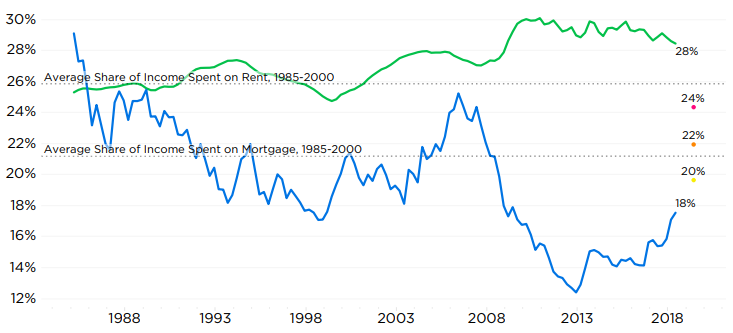
Data show that today many Americans are spending more of their income on rent than they are on mortgage payments. From 1985 to 2000, the share of income spent on mortgage payments was 21 percent; in Q2 2018 it was 18 percent. Conversely, from 1985 to 2000 the share of income spent on rent was slightly higher at 26 percent and has risen to 28 percent as of Q2 2018. As many individuals and families look to make the step from renting to owning their own home to create greater stability and build long-term equity, it’s essential that these individuals have prudent low down payment options – such as private MI – available for their future homeownership needs.

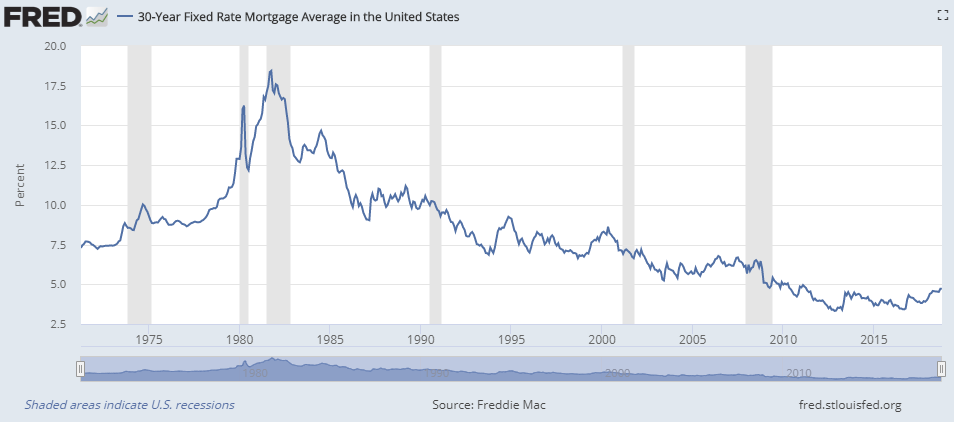
In addition to the wealth creation that homeownership fosters, today’s historically low mortgage interest rates are a good reason to buy a home now. Over the course of nearly 35 years, the housing market has experienced an extraordinary decline in mortgage interest rates. In 1981, the average rate for a 30-year fixed-rate mortgage stood at over 18 percent; it stood at approximately 4.72 percent at the end of September 2018. Borrowers should take advantage of these historically low mortgage interest rates because housing finance experts forecast that this interest rate decline is over, and primary mortgage rates are on the rise.

Homebuyers shouldn’t sit on the sidelines and put off buying the home of their dreams simply because they aren’t in the position to put 20 percent down. Since 1957, MI has helped millions of Americans – particularly first-time homebuyers – become successful homeowners, and it will continue to be a foundation of the housing market and a resource for borrowers in the years to come.

Blog: Take a Second Look at Your Homebuying Options

Buying a home is an exciting process, but for many people it can also seem out of reach. While many renters would like to buy, there are several factors that may lead potential homebuyers to believe they may not be ready. These include credit score requirements, income and debt levels, and the common myth that a 20 percent down payment is needed. Here is some good news: Qualifying for a mortgage may not be so far out of reach.

While it is true that borrowers with stronger credit profiles—FICO scores of 720 and higher, low debt-to-income (DTI) ratios, and cash reserves—generally receive better mortgage terms, there are products in the market that can enable access to affordable, prudently underwritten mortgage financing.

Down payment is routinely cited by prospective homebuyers as the largest hurdle to homeownership, but low down payment mortgages are widely available in today’s market. These include conventional loans with private mortgage insurance (MI) and government-backed loans like those insured by the Federal Housing Administration (FHA).

Many borrowers incorrectly believe that they need a 20 percent down payment to buy a home, but with private MI a borrower can qualify for a conventional home loan with as little as 3percent down. In addition to the competitive pricing of mortgages backed by private MI, private MI can be canceled when a borrower reaches 20 percent equity in his or her home. This added perk often makes private MI a more affordable option over other home loan programs—such as FHA-backed home loans—which require mortgage insurance premiums for the vast majority of borrowers for the entire term of the mortgage, which is often 15 or 30 years.

For more than 60 years, more than 30 million homeowners have used private MI to successfully buy homes and build the long-term wealth associated with home equity. In 2017 alone, private MI helped more than one million borrowers nationwide purchase or refinance a mortgage. According to a study by U.S. Mortgage Insurers, 56 percent of those borrowers who received purchase loans were first-time homebuyers and more than 40 percent had incomes below $75,000.

For decades, millions of homeowners and prospective homebuyers have relied on private MI to help them affordably and responsibly buy a home. Based on median home prices, it can take an average of 20 years to save for a 20 percent down payment. And with home prices dramatically on the rise, this wait time will only increase. Luckily, private MI can help you get into the home of your dreams sooner.

When making homebuying decisions, it is important to take a second look to make sure you are aware of all your options. Check out lowdownpaymentfacts.org to learn more.

Blog: House Financial Services Hearing Examining 10 Years of Fannie Mae and Freddie Mac under Government Conservatorship

WASHINGTON — Lindsey Johnson, President of U.S. Mortgage Insurers (USMI), today published the following blog on USMI.org in response to today’s U.S. House Financial Services Committee hearing entitled “A Failure to Act: How a Decade Without GSE Reform Has Once Again Put Taxpayers at Risk”:

“Today’s hearing on the GSE’s (Fannie Mae and Freddie Mac) 10 years in government conservatorship—after U.S. taxpayers provided a $187 billion bailout during the financial crisis—serves as an important reminder that the housing finance system still needs serious reform. While Fannie and Freddie are healthier today thanks to a prolonged period of favorable economic and housing conditions, and new safeguards that have improved the stability of the overall mortgage finance system, we must work to ensure the system is put on a stable footing for the long term. Policymakers should consider reaffirming boundaries for the GSEs in the secondary mortgage markets, reducing their duopolistic market power to level the playing field for competitive private capital opportunities, and increasing transparency in the GSEs’ operations so that all participants in the housing finance system have the clarity they need to foster and support a healthy and accessible mortgage market.

“Since the GSEs were placed into conservatorship, their footprint, market dominance, and reach into the mortgage finance system has expanded. USMI continues to be concerned with the GSEs’ mission creep and the lack of transparency in certain GSE expanded activities. For example, the financing of mortgage servicing rights for a select group of non-bank lenders; new credit enhancement mechanisms, like Freddie Mac’s IMAGIN and Fannie Mae’s EPMI pilot programs, that seek to disintermediate private capital; and participating in single-family rental pilot programs, among others. Many of these new products and activities raise alarms about the GSEs’ expanding roles in the housing finance system without a clear rational or need as they represent a significant blurring of the bright line separation between primary market and secondary market activities, as well as greater vertical integration of private sector activities into the GSEs.

“The Federal Housing Finance Agency recently announced it is ending the GSEs’ single-family rental pilot programs, which it said it was doing on a ‘test and learn basis,’ citing that it has since learned the market can function without the GSEs. FHFA needs to end other GSE pilots and programs that encroach on private market functions, including the IMAGIN and EPMI products introduced earlier this year.

“There is a robust and healthy private mortgage insurance market that is meeting the market’s needs and it is unnecessary for the GSEs to compete directly with the private sector. The GSEs should not be allowed to create programs that crowd out a time-tested, robustly regulated, and highly capitalized industry that facilitates prudent access to low down payment mortgage financing across the country and on a permanent basis through various economic cycles.

“To achieve comprehensive reform, USMI believes certain principles must be met that will guarantee a robust housing finance system that promotes successful and affordable homeownership. These principles include establishing a coordinated housing policy that promotes private capital ahead of taxpayer exposure, enabling access to homeownership and affordable mortgage credit with private mortgage insurance, and deepening the level of mortgage insurance currently used with conventional low down payment loans. It is long overdue that we strike the right balance for taxpayers in establishing complementary roles for the Federal Housing Administration and the conventional low down payment mortgage market, which is predominately guaranteed by private mortgage insurance.

“Since 1957, mortgage insurers have supported the U.S. housing market, enabling homeownership opportunities for nearly 30 million Americans by providing insurance on mortgage loans where borrowers cannot afford a 20 percent down payment. USMI will continue to work with Congress and the administration to create a more coordinated, consistent, and transparent housing system—a system that can expand private capital’s role in shouldering more risk in front of taxpayers.”

On September 5, USMI joined 28 other organizations on a letter to Congress and the Administration calling for GSE reform.

Blog: 5 Questions to Ask When Shopping for a Mortgage

Buying a home is a major financial commitment. It’s exciting, but can also be confusing and overwhelming. Choosing the best mortgage that fits your needs is an important first step and first-time homebuyers in particular should research the many options and know the right questions to ask. Here are some questions to ask a lender that will help you make an informed mortgage decision:

* How much can I afford? A home affordability calculator can help you get an idea of what you may be able to afford and keep your monthly payments within your budget. In addition to recurring expenses like car payments, student loans, credit cards and disposable income, be sure to consider other monthly expenses related to the new home, like association fees, homeowners’ insurance, utilities and property taxes. Further, some types of mortgages have firm eligibility cutoffs related to the ratio between a buyer’s total debt amounts and their monthly income.

* How much do I need for a down payment? It’s a common misconception that a 20 percent down payment is required to buy a home. Let’s face it, a 20 percent down payment is a lot of money, and often the largest obstacle for homeownership, especially for first-time buyers. You can qualify for a conventional mortgage with as little as 3 percent down. Conventional mortgages originated with a low down payment, which is defined as less than 20 percent, require private mortgage insurance (MI) until approximately 20 percent equity is established through either monthly payments or home price appreciation. When mortgage insurance cancels, your monthly mortgage bill is reduced. It is important to know that not all forms of MI are created equal — private mortgage insurance is temporary and cancelable but the overwhelming majority of mortgages backed by the government’s Federal Housing Administration (FHA) contain insurance that cannot be canceled.

* What is the interest rate and is it fixed? Most first-time homebuyers go with a 30-year fixed-rate mortgage, which locks you into an interest rate with steady, predictable payments. Different lenders may offer different rates, so make sure to contact several lenders to ensure you’re getting the best option available in the market. A rate lock protects you from rising interest rates while the loan is being processed and lasts for a specific amount of time. In addition, make sure you know whether the rate is fixed or “adjustable.” Adjustable rate mortgages, commonly referred to as “ARMs,” result in periodic adjustments in the interest rate based on the lender’s cost of credit, and can be detrimental to homeowners in rising interest rate environments. Finally, ask if you are paying for “points” to reduce the interest rate. It’s an added upfront cost paid at closing, but it results in a lower rate for the life of the loan.

* Does my credit score matter? Yes, generally stronger credit scores (FICO 720 and above) come with better interest rates, but fortunately there are mortgage options for those with imperfect credit scores too. When you apply for a mortgage, your credit record is used to help determine your approval and mortgage terms, but it is not the only thing lenders consider. A lender will also look at your debt-to-income (DTI) ratio, cash reserves and other factors to help gauge your overall creditworthiness.

* Should I get pre-approved for a mortgage? Yes. Pre-approval means you receive a conditional commitment from a lender up to a specific loan amount. In a seller’s market with tight housing supply, being pre-approved demonstrates that you are a serious buyer with access to mortgage financing. To become pre-approved, you’ll provide your lender with information on your income, assets, debts and credit history to analyze your financial profile and determine your creditworthiness and amount you can borrow to purchase a home.

Make sure to know your options and choose the one that works for you. Check out lowdownpaymentfacts.org to learn more.

Blog: Mortgage Insurance is an Enduring Piece of Housing Finance Reform

By Lindsey Johnson

While discussing 2018 housing finance reform recently, specifically private mortgage insurance’s role in helping homebuyers and protecting lenders and the GSEs in the mortgage finance system, I was reminded of one of the most significant reasons MI is uniquely valuable: it is compatible with nearly every form of mortgage credit execution. While there are pilot projects underway at Fannie Mae and Freddie Mac experimenting with other forms of credit risk transfer (“CRT”), private mortgage insurance is the original form of CRT. MI is credit enhancement for borrowers with a low-down payment, and it has been a sustainable component of America’s housing finance system for more than 60 years.

Proposals and recommendations to reform the GSEs are being floated by government agencies and lawmakers, financial experts, academics, think tanks, and housing organizations. While these proposals seek the same goal of achieving much needed reform, there are many different ideas for what reform should achieve.

For more than six decades, private mortgage insurance has played a critical role in helping first time buyers—especially those without a large down payment—achieve affordable home financing while also protecting lenders (and the government and taxpayers when these mortgages are securitized by Fannie Mae and Freddie Mac). MI should continue to provide this important function in the housing system of tomorrow.

But more than being compatible, the timing of mortgage insurance matters too. When we talk about “loan level” or “front-end” or “at origination” credit enhancement we are specifically referring to how MI is part of a low-down payment mortgage from day one. When a homebuyer sits down at the settlement table to sign paperwork and get their keys, the mortgage is insured. Just like you are required to have auto insurance before you drive your car, the protection on these mortgages is present before the homebuyer moves in. Mortgage insurance is part of a low-down payment conventional mortgage if the loan is held on a bank’s portfolio for a period of time or whether it is pooled with others and securitized by Fannie Mae or Freddie Mac—the protection on the individual loan remains present. And it’s a good thing, too, considering private mortgage insurers paid over $50 billion in claims through the down turn – losses the government and taxpayers didn’t have to bear. This is important because, while it is a positive step for the GSEs to experiment with other forms of CRT in the system, these new alternatives are not the same and shouldn’t be considered interchangeable.

Many of the benefits of MI come from the fact that it attaches to the loan at the time the loan is originated, something that should occur in any future system for the reasons discussed below.

What are the unique benefits of MI?

  • Loan-level insurance is a form of credit enhancement that most aligns with borrowers, servicers, and investors to not only put borrowers into homes, but also to keep them there. MI is unique because it actively manages credit risk, reducing risk on individual low-down payment loans while affording lenders flexibility for secondary market execution, whether through the GSEs, Federal Home Loan Bank System, private securitization, or to hold loans on portfolio. Being part of the loan from the time it is originated allows mortgage insurers to provide a second set of eyes when it comes to underwriting, helping to ensure the buyer can afford the mortgage. MIs have decades of experience and expertise in pricing and managing mortgage credit risk to balance affordability and risk sensitivity—something unique to MI that is not available through most other forms of credit enhancement. Because MIs are in the first-loss position (meaning they are the first to pay losses in a default after the borrower’s down payment)—MIs have the incentive to use strong underwriting, which strengthens the mortgage finance system.  Also, unlike other CRT structures, because MI is done at the individual loan level, MIs have a strong incentive to help borrowers achieve a workout to stay in their home rather than to default.
  • MI is compatible with different housing finance systems. MI protection travels with a home loan wherever it goes, including being added to a lender’s balance sheet, sold to an investor, or placed into a securitization pool. As a result, unlike with other CRT pilot programs, MI does not rely on the GSEs or other government or quasi-government entities to hold and distribute credit risk. Private MI is fully compatible with the broadly shared goal of a housing finance system with multiple funding sources and substantial private capital—a feature that distinguishes MI from other forms of credit enhancement.
  • Private MI can transition smoothly across the housing finance system. While the other CRT pilots were built to operate only within the Fannie Mae and Freddie Mac construct, the MI industry has historically adapted as the mortgage finance system evolved—from the dominance of Savings & Loan associations to the growth of the GSEs and independent mortgage bankers. The MI industry has the continued ability to evolve and serve any new system that is created with virtually no disruption to the origination and servicing of mortgage loans.

Understanding that our options for a reformed housing finance system is not constrained to a single model, and that a permanent source of private capital can be available under these different constructs, allows policymakers and stakeholders to examine the best system for addressing the concerns/flaws that exist today and how to make a more effective and efficient system in the future. Since 1957, the MI industry has helped more than 25 million families become homeowners while protecting the taxpayers and the federal government from mortgage credit risk. MI will continue to promote homeownership and taxpayer protection in a new housing finance system.

Blog: Do the math: Homebuying now may save a lot

It is a common misconception that a 20 percent down payment is required to buy a home. Advice to wait and save a large down payment is often based on the theory that the cost of mortgage insurance (MI), which is required when you buy with a smaller down payment, should be avoided. This may not be the best advice and is, in fact, not in line with market trends, considering 60 percent of homebuyers buy with a down payment of 6 percent or less, according to the National Association of Realtors.

Yes, you can qualify for a conventional mortgage with a down payment as small as 3 percent of the purchase price. It is also true that you can reduce your monthly mortgage payment by paying for discount points at closing, but that can be 5 or 10 percent of the purchase price — not 20. And because every buyer’s situation is unique, it’s important to do the math. In today’s market, it could take a family earning the national median income up to 20 years to save 20 percent, according to calculations by U.S. Mortgage Insurers using a methodology developed by the Center for Responsible Lending; a lot can change during that time, in the family’s personal finances and in overall mortgage market trends.

How can buying now save you money later?

Consider you want to purchase a $235,000 home. A 5 percent down payment is $11,750 versus $47,000 in cash for 20 percent down. With a 740 credit score at today’s MI rates, your monthly MI payment would be about $110, which is added to your monthly mortgage payment until MI cancels. MI typically cancels after five years; therefore, you will only have this added cost for a short period of time versus waiting an average of 20 years to save for 20 percent.

With home price appreciation, today’s $235,000 home will likely cost more in the years ahead and this will also have an impact on the necessary down payment and length of time required to save for it. There are other variables in the equation too, such as interest rates. As federal rates rise, so too can the costs associated with financing a mortgage. The savings a borrower might calculate today could be altogether negated by waiting even a few more years. Another factor is that rents are on the rise across the nation, leading to a reduced capacity for many would-be homebuyers to save for larger down payments.

If you decide to buy today with a low down payment mortgage option, it is true that MI is an added cost on top of mortgage principal and interest, but keep in mind that it is temporary and goes away. Again, it typically lasts about five years. Private MI can be cancelled once a homeowner builds approximately 20 percent equity in the home through payments or appreciation and automatically terminates for most borrowers once he or she reaches 22 percent equity. And when MI is cancelled, the monthly bill goes down. Importantly, the insurance premiums on an FHA mortgage — the 100 percent taxpayer-backed government version of mortgage insurance — cannot be cancelled for the vast majority of borrowers with FHA mortgages.

So, do the math and let the numbers guide you. There are many online mortgage calculators that can help. Check out lowdownpaymentfacts.org to learn more.

Blog: How to lower your monthly mortgage payment

Owning your own home comes with many advantages, including escaping rising rents and the personal and financial stability associated with homeownership. Fortunately, millions of Americans, with less than 20 percent down, have been able to buy a home sooner thanks to mortgage insurance (MI). If you don’t put down 20 percent of the mortgage cost, you will likely be required to purchase MI, which enables low-down-payment borrowers to qualify for home financing from lenders.

While homeownership has many benefits and continues to be part of the American Dream, it is not without costs. Several surveys have found that the majority of first-time homebuyers — over 80 percent according to one study — put less than 20 percent down. For these borrowers, there is usually the added expense of MI, which may give some of these borrowers pause.

But there is good news: the monthly private mortgage insurance premiums do not last forever on most conventional loans. And when private MI (PMI) cancels, homeowners will have more cash in their pockets each month — money that is available for home improvements or other goals. It is important to understand, however, that not all MI is the same, and not all MI can be canceled.

There are numerous low-down-payment mortgage options available that include MI. The two most common are: (1) home loans backed 100 percent by the government through the Federal Housing Administration (FHA) that include both an upfront and annual mortgage insurance premium (MIP); and (2) conventional loans, which are typically backed at least in part by private sources of capital, such as private MI. The key difference is that one form can be canceled (PMI) while the other (FHA) typically cannot be canceled.

An FHA loan can be obtained with a down payment as low as 3.5 percent. However, be aware that you will typically have to pay a mortgage insurance premium (MIP) of 1.75 percent of the total loan amount at closing or have it financed into the mortgage. In addition to your regular monthly mortgage payments on your FHA loan, you will also pay a fixed monthly MIP fee for the life of the loan. This means you could pay hundreds of dollars extra every month — thousands over the life of the loan — until you pay off the entirety of the loan.

If you obtain a conventional loan with PMI, you can put as little as 3 percent down. Like an FHA loan, PMI fees are generally factored into your monthly mortgage payment. However, PMI can often be canceled once you have established 20 percent equity in the home and/or the principal balance of the mortgage is scheduled to reach 78 percent of the home’s original value. This means that the rest of your mortgage payments will not include any extra fees, so that your payments go down in time, saving you money each month. What you save in the long run can then be put toward expenses like home renovations, which can further increase your home’s value.

MI is a good thing because it bridges the divide between a low down payment and mortgage approval. But not all MI is created equal. If you want to buy a home but still save in the long run, PMI might be the right option for you. Check out lowdownpaymentfacts.org to learn more.
Blog: A smarter way to buy a home

Are you considering buying a home? With mortgage rates on the slow and steady incline, there may be no better time for a home purchase than now. Mortgage interest rates will likely continue to go up for the foreseeable future, according to recent data from the housing finance company Freddie Mac. Many housing experts and industry observers agree.

What does this mean?

If you are thinking about buying a home, it means don’t wait any longer. The overall cost of buying a home in the future will only increase compared to buying a home of the same value today. Furthermore, rising interest rates impact housing inventory, as sellers might not be as interested in moving if it means paying a higher rate on a new mortgage. As a result, the dream home you see today might not be available next year.

The 20 percent down myth

If you’ve put off buying your next home to save for the full 20 percent there is good news: you don’t need it. If you were unaware of this, you’re not alone. A recent survey found that among first-time homebuyers who obtained a mortgage, 80 percent made a down payment of less than 20 percent. While there are several low down payment mortgage options available, only one has a 60-year history of being a steadfast, smart way to get into a home: a conventional loan with private mortgage insurance (MI).

What is a conventional loan with MI?

A conventional loan is a mortgage from a lender that is not completely backed by the federal government. For qualified borrowers with a low down payment, private MI is required and typically paid monthly along with the mortgage payment. You can obtain this type of loan with as little as 3 percent down, though buying with a 5 percent down payment will result in a lower monthly payment.

There are other types of low down payment options that also include MI, such as the government-insured loans backed by the Federal Housing Administration (FHA). Unlike the premiums charged by FHA loans, private MI premiums can be cancelled once 20 percent equity in home value is reached, and with private MI there are no upfront costs added onto a borrower’s initial down payment like there are with an FHA loan. This means your monthly bill decreases and you have extra money to spend on your family, vacations, retirement and any other needs.

Don’t sit on the sidelines and miss out on your dream home. To learn more about mortgage insurance compared to other low down payment options, visit LowDownPaymentFacts.org.

Blog: Private Mortgage Insurance at 60 Years — Lindsey Johnson interviews USMI Board Chairman Pat Sinks

By Lindsey Johnson

What was the driving force in 1957 that led to the inception of private mortgage insurance (MI)?

While the late 1950s was a time of great economic prosperity, the devastating effects of the Great Depression and World War II still impacted how financial institutions viewed risk. These institutions were leery of issuing mortgages with less than 20 or 25 percent down, unless the Federal Housing Administration (FHA) insured them. However, the red tape, expense, and regulations involved in working with the FHA made it impractical for many banks to lend and served as a barrier to homeownership for many low- to moderate-income borrowers. As a result of the precarious mortgage lending situation, a real estate attorney based in Milwaukee, WI named Max Karl sought a way to allow banks to more efficiently serve borrowers with low down payment loan options by insuring home loans with private MI. To do this, Karl founded Mortgage Guaranty Insurance Corporation (MGIC) and the rest is history.

Since 1957, how has private MI helped support homeownership?

Having mortgage insurance makes originating high loan-to-value (LTV) loans safer for the financial institutions we serve, allowing them to reduce their risk and lend to credit-worthy borrowers who bring less than 20 percent down to the table. This allows borrowers to become homeowners sooner than would otherwise be possible. It also allows homeowners to build the kind of long-term wealth that comes with having equity in a home.

Why should borrowers consider private MI?

I encourage borrowers to thoroughly explore all home loan options when buying a home; being well informed is the key to making the best choice based on one’s individual needs. That said, private MI offers an affordable and sustainable low down payment path to homeownership. What’s more, unlike some other low down payment programs, private MI automatically cancels once a homeowner reaches 78 percent equity in his or her home (or 80 percent equity upon request) and meets investor and/or Homeowner Protection Act requirements. This benefit of private MI can save homeowners thousands of dollars over the life of their loan.

How does private MI fit into the mortgage finance system?

Simply put, private MI helps reduce risk in the mortgage financing system by putting private capital in front of taxpayers and the federal government. Private MI does this by meeting a requirement established by Congress that low down payment loans sold to the government-sponsored enterprises Fannie Mae or Freddie Mac (the GSEs) have extra credit protection.

If the borrower defaults on their loan and there isn’t enough equity in the home to cover what is owed on the mortgage, private MI is there to offset the loss. With the GSEs in conservatorship and the government effectively guaranteeing the loans assumed on the GSEs’ balance sheets, taxpayers face direct exposure to mortgage credit losses experienced by the GSEs. When private MI is in place, private capital – not taxpayers – cover the first losses on a default up to certain coverage limits.

To give you an idea of what that means in real dollars, the private MI industry has paid more than $50 billion in claims for losses to the GSEs since they entered conservatorship during the 2008 financial crisis

What’s changed in the private MI industry over the past 60 years?

I like to say “this isn’t our father’s MI.” The private MI industry has been through a lot in its 60-year history. Most recently, we learned some valuable lessons during the Great Recession. Prior to that, the industry had never experienced a coast-to-coast collapse in the housing market. It’s true there have been times of great economic hardship during the industry’s history, but nothing as widespread as this most recent economic downturn.

While the private MI industry’s commitment to helping expand homeownership in an affordable, sustainable way remains steadfast, it has incorporated the lessons learned from the Great Recession into how it operates today. This includes the industry’s capital standards and how it views, evaluates, and prices for risk.

These lessons have made the private MI industry a stronger partner with its customers and it is in a great position for the future.

Speaking of the future, what do you see for private MI going forward?

The private MI industry is in the midst of a once in a generation opportunity to positively reform the country’s housing finance system. To do it right, there must be a comprehensive approach to evaluate what the proper role is for the GSEs, FHA, and private capital.

Private mortgage insurers are ready, willing, and able to take on a larger role in housing finance. The industry’s transparent, risk-adjusted capital requirements set it apart from other forms of credit enhancement, and that stability – coupled with 60 years of experience insuring high LTV-residential mortgages – puts it in a unique position to support the expansion of homeownership.

As our county’s leaders continue to explore housing finance reform, it only makes sense for them to consider how they can leverage the private MI industry’s inclusive and scalable business model.