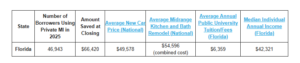



WASHINGTON, DC — A new report released today by U.S. Mortgage Insurers (USMI) shows that private mortgage insurance (MI) helped more than 800,000 low down payment borrowers qualify for home financing in 2025. On average, these borrowers saved an estimated $48,000 in cash needed at closing compared to saving up for a 20% down payment – nearly enough to buy a new car, cover tuition and fees at the average public university, or remodel both a kitchen and bathroom. This allowed hundreds of thousands of households to become homeowners years sooner than would otherwise be possible.
Collectively, the report found that private MI has saved American homebuyers more than $285 billion in down payment costs since 2020, including more than $35.3 billion in 2025 alone. What’s more, publicly reported data confirm that the cost of private MI, as measured by in-force premium yields, has, in stark contrast to other costs of homeownership, declined 25% since 2017 – reaffirming that the small, temporary cost of monthly private MI paid by the borrower provides homebuyers, lenders, the government-sponsored enterprises (GSEs), and taxpayers with outsized benefits. The new report further details how private MI is strong and resilient private capital that provides stability to the housing market and broader financial system.
“Homeownership has been a cornerstone of the American Dream for 250 years and private mortgage insurance puts that dream within reach for hundreds of thousands of households,” said Seth Appleton, President of USMI. “This new report demonstrates the tremendous savings that private MI provides and underscores that it is a powerful financial tool that allows families to unlock homeownership years or even decades sooner than would otherwise be possible.”
National Trends
The new USMI report also found:
- Over 800,000 households in 2025 used low down payment mortgages backed by private MI.
- The average $48,000 saved in cash needed at closing is nearly the price of a new car (per Kelley Blue Book/Cox Automotive), covers roughly four years of tuition and fees at the average public in-state university ($11,950 per year, per the College Board), or is enough to remodel both a kitchen ($26,943 on average) and a bathroom ($15,586 on average), with money left over.
- 64% of purchasers with private MI in 2025 were first-time homebuyers.
- $376,317 was the average loan amount for a home purchase backed by private MI in 2025.
- Saving for a 20% down payment could take the typical potential homebuyer 25 years.
- The total value of mortgage originations supported by private MI in 2025 was more than $311 billion.
- As of the end of 2025, the industry insured more than $1.6 trillion of mortgages, including $1.4 trillion of mortgages backed by Fannie Mae and Freddie Mac (the GSEs), protecting the housing finance system and taxpayers from credit risk.
- The private MI industry has covered more than $62 billion in claims for losses since the 2008 financial crisis.
- Nearly 41 million borrowers have benefited from private MI since 1957.
Top Five States Where Borrowers Used Private Mortgage Insurance in 2025
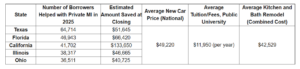
Texas, Florida, California, Illinois, and Ohio ranked as the top five states for mortgage financing with private MI in 2025. This is the third year in a row these states ranked in the top five for private MI use.
Why Use Private Mortgage Insurance?
Private MI helps low down payment borrowers access affordable mortgage financing while protecting the GSEs, lenders, investors, and taxpayers against risk. Private MI enables a borrower to qualify for mortgage financing with a down payment as low as 3%. Borrower-paid monthly private MI, the most commonly used form, is only a temporary cost for homebuyers, as it can be canceled or automatically terminates once the loan meets certain requirements.
Amassing a large cash down payment can be one of the biggest hurdles to homeownership, particularly for first-time buyers. Private MI allows borrowers – who are not able to put down 20% – to qualify for a conventional loan by insuring the lender against potential losses in the event the borrower is unable to repay the loan and there is not sufficient equity in the home to cover the amount owed. USMI’s 2024 Homeownership Market Survey found that while homeownership is very important to survey respondents, only one-third of them were aware that it is possible to qualify for financing with only 3% or 5% down.
A Second Round of Savings at Tax Time
Beginning next tax season, private MI carries additional benefits for qualifying homeowners thanks to the Working Families Tax Cuts which permanently reinstated the deductibility of private and government MI premiums for eligible homeowners. This action by Congress and President Trump means the return of a deduction that provides working-class homeowners with meaningful tax relief without increasing risk in the housing finance system. USMI has long advocated for the reinstatement of this deduction, which was claimed more than 44 million times for tax years 2007-2021, for a collective $64.7 billion in deductions. In 2021, the last year this deduction was available, qualifying homeowners received an average deduction of $2,364, according to IRS data. Additionally, the 2017 Tax Cuts & Jobs Act included cost savings that were passed on to low down payment homebuyers in the form of lower private MI premium rates.
Private Mortgage Insurance Protects Taxpayers
For nearly seven decades, private MI has served as the first layer of private capital protecting the housing finance system from unnecessary risk. Private MI is scalable and serves lenders of all sizes and business models, from the largest global institutions to the smallest community banks. It has also proven to be a reliable method for shielding the GSEs, lenders, investors, and taxpayers from losses, having paid $62 billion in claims since the 2008 financial crisis and housing market downturn. That’s $62 billion covered by private capital rather than taxpayers and the federal government. The private MI industry’s ability to employ risk-based pricing to granularly assess, price, and manage long-term mortgage credit risk also allows private MI companies to provide further protection to the GSEs and taxpayers.
The complete report is available here, along with fact sheets for all 50 states and the District of Columbia.
###
USMI is dedicated to a housing finance system backed by private capital that enables access to housing finance for borrowers while protecting taxpayers. Private mortgage insurance offers an effective way to make mortgage credit available to more people. USMI is ready to help build the future of homeownership. Learn more at www.usmi.org