

Statement: FHA’s FY2025 Annual Financial Report to Congress

WASHINGTON Seth Appleton, President of U.S. Mortgage Insurers (USMI), the association representing the nation’s leading private mortgage insurance (MI) companies, issued the following statement on the release of the Federal Housing Administration’s (FHA) Fiscal Year 2025 Annual Report to Congress on the financial status of the Mutual Mortgage Insurance Fund (MMIF):

“FHA must remain well-capitalized in order to perform its critical countercyclical function in America’s housing market and enable access to mortgage credit for those who may not otherwise be able to secure financing through the conventional and portfolio mortgage markets that are backed by private capital. We commend HUD Secretary Scott Turner and FHA Commissioner Frank Cassidy for their prudent stewardship of the MMIF in 2025. While the MMIF Capital Ratio stands at 11.47% with Total Capital Resources for the forward program at 8.25%, USMI urges policymakers to continue the current disciplined approach to ensure the long-term health of the MMIF, while also considering modernized stress-based, loan-level risk-weighted standards for FHA similar to the frameworks applied to Fannie Mae and Freddie Mac (the GSEs) and the private MI industry in order to withstand times of severe economic stress.”

To increase transparency around the fiscal condition of the MMIF and FHA’s forward mortgage program and contextualize the numbers published in the Annual Report, USMI previously commissioned a third-party actuarial firm to estimate the risk-based capital FHA would be required to hold if subject to the same stress-based, loan-level risk-weighted capital frameworks as private mortgage insurers and the GSEs, as compared to FHA’s Total Capital Resources for the forward program stated in last year’s Annual Report to Congress.

If held to the same capital standard that private mortgage insurers must meet to insure loans acquired by the GSEs in the conventional market, the Private Mortgage Insurer Eligibility Requirements (PMIERs), it is estimated that FHA’s Total Capital Resources for the forward program, as of the end of FY2024, would run a $31.7 billion shortfall. Similarly, as of the end of FY2024, FHA would need to hold $50 billion more to meet the GSEs’ capital framework’s minimum requirement if applied to FHA’s book of business.

Read USMI’s full policy brief here to learn more about why policymakers should consider modernizing FHA’s Capital Ratio to ensure safety and soundness in the housing finance system.

Statement: Senate Confirmation of FHA Commissioner, Ginnie Mae President, and FDIC Chairman

WASHINGTON Seth Appleton, President of U.S. Mortgage Insurers (USMI), released the following statement regarding the Senate confirmation of Frank Cassidy as Federal Housing Administration (FHA) Commissioner, Joseph Gormley as President of the Government National Mortgage Association (Ginnie Mae), and Travis Hill as Chairman of the Board of Directors for the Federal Deposit Insurance Corporation (FDIC) by a vote of 53-43:

“USMI congratulates Frank Cassidy on his confirmation to serve as Assistant Secretary of Housing and Federal Housing Commissioner. Mr. Cassidy brings extensive experience in real estate and housing finance, and we look forward to working with him in this new role in support of mortgage financing that is affordable, accessible, and sustainable for working class families across the country while at the same time promoting safety and soundness in the U.S. housing finance system.”

“USMI further congratulates Joseph Gormley on his confirmation as President of Ginnie Mae, and Travis Hill on his confirmation as Chairman of the FDIC Board of Directors. We look forward to working with Mr. Gormley to promote a safe, sound, and liquid housing finance system, and with Mr. Hill to make prudent updates to bank capital rules that balance access to mortgage credit for low down payment homebuyers with a financially stable housing finance system.”

###

U.S. Mortgage Insurers (USMI) is dedicated to a housing finance system backed by private capital that enables access to housing finance for borrowers while protecting taxpayers. Private mortgage insurance offers an effective way to make mortgage credit available to more people. USMI is ready to help build the future of homeownership. Learn more at www.usmi.org.

Blog: Private Mortgage Insurance: A Powerful Tool To Buy A Home That Has Declined In Cost

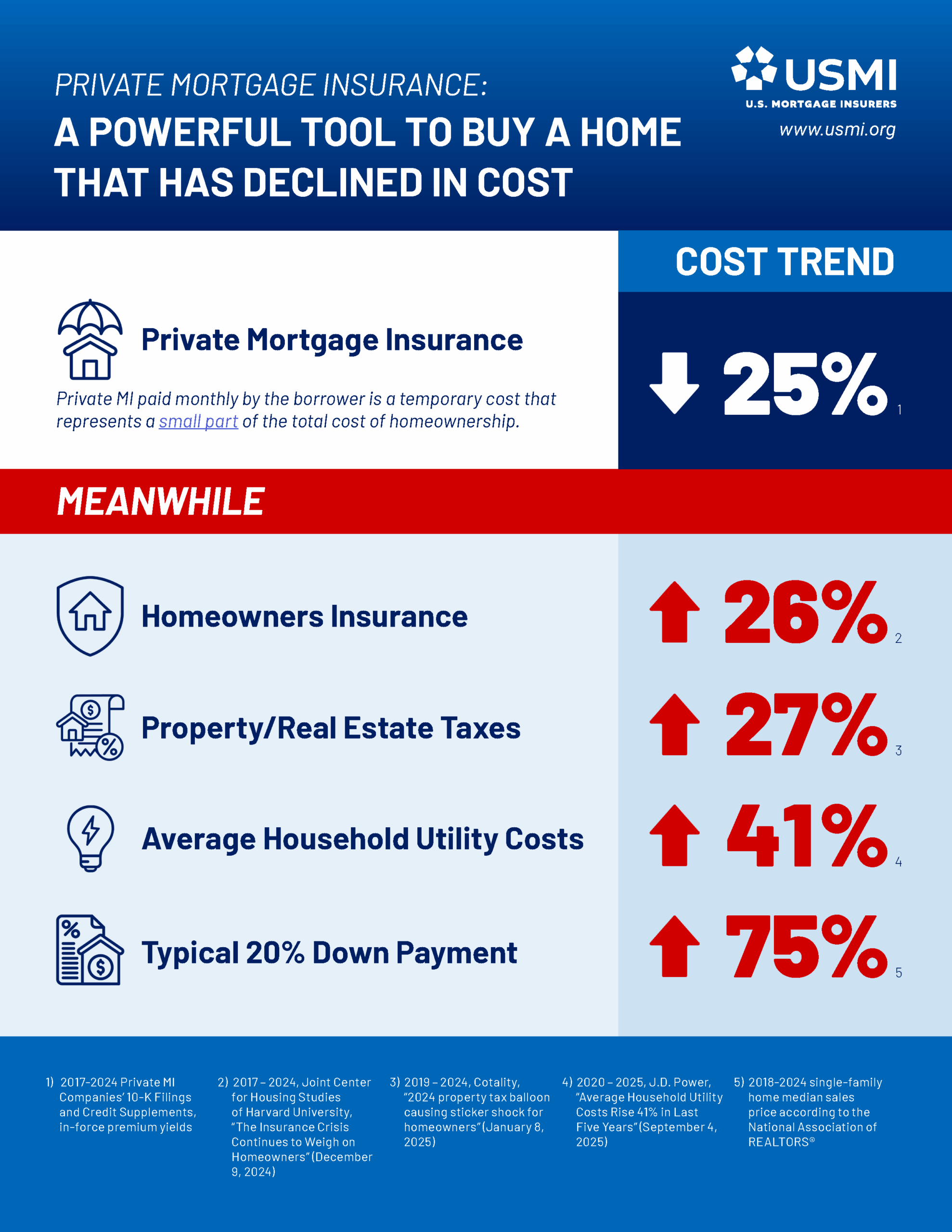
Private mortgage insurance is a powerful tool to buy a home that helps borrowers become homeowners with tens of thousands less at the closing table and without having to save for a 20% down payment. Private MI paid monthly by the borrower is a temporary cost that represents a small component of the total cost of homeownership. What’s more, private MI has declined in cost in recent years. Unlike other costs associated with homeownership that have increased significantly, such as homeowners insurance, property/real estate taxes, average household utilities, and the amount of money needed for a down payment, the cost of private MI has decreased by 25% based on in-force premium yields. See here or below for USMI’s new infographic detailing this striking difference!