

Op-Ed: 2021: Democrats Driving the Agenda

By Brendan Kihn, Government Relations Director of U.S. Mortgage Insurers (USMI)

With the New Year came both a new Administration and a new Senate majority. Having held the House, winning back the White House, and securing the January elections in Georgia to flip the Senate, the Democrats have a trifecta in D.C. for the first time since January 2011. For Democrats, the electoral wins present an opportunity to push forward a much more complete policy agenda. However, given the narrow majorities in both chambers of Congress, Democrats will still have limits on what is attainable, as they will need every Democratic vote, and possibly a few Republican votes to pass key legislation.

Full Steam Ahead on COVID Relief and Financial Equity

Rep. Maxine Waters (D-CA) became the chair of the House Financial Services Committee (HFSC) in January 2019, making history as the first woman and African American to hold the position. Chairwoman Waters used her gavel to conduct extensive oversight of the various agencies under her jurisdiction, including the Consumer Financial Protection Bureau (CFPB), Federal Housing Finance Agency (FHFA), U.S. Department of Housing and Urban Development (HUD), and the National Credit Union Administration (NCUA). Chairwoman Waters embarked on an ambitious agenda, which quickly became consumed by the need to respond to the COVID-19 pandemic in early 2020.

Fast forward to 2021, Chairwoman Waters has made it clear that she intends for HFSC to continue its important focus on COVID-19 related financial services issues and COVID-19 relief, as well as advancing policies that promote economic fairness, advance financial inclusion, and hold oversight of financial institutions and their regulators. Congressional Democrats and President Biden are in alignment with policies that advance equity – not merely “equality” – as evidenced by the Administration’s January 26 memo to HUD that recognized the ongoing legacies of systemic racism, and stated that the “Federal Government shall work with communities to end housing discrimination, to provide redress to those who have experienced housing discrimination, to eliminate racial bias and other forms of discrimination in all stages of home-buying and renting, to lift barriers that restrict housing and neighborhood choice, to promote diverse and inclusive communities, to ensure sufficient physically accessible housing, and to secure equal access to housing opportunity for all.”

What does this mean for housing? As the primary way that American families attain financial stability and build long term generation wealth, homeownership will be a critical component of the Democratic push toward addressing the persisting racial wealth gap. Specifically, look for HFSC to act on policies that:

  • Increase access to affordable mortgage credit via first-time homebuyer tax credits (in conjunction with the House Committee on Ways and Means), targeted down payment assistance (DPA) programs, and 529-like down payment savings accounts.
  • Increase homeownership rates among minority communities and close the racial homeownership gap.
  • Ensure fair lending through robust oversight of lenders and support of reinstating the Obama-era Affirmatively Furthering Fair Housing rule.
  • Include the construction of affordable housing as part of an infrastructure package and as outlined in Chairwoman Waters’ bill, “Housing is Infrastructure Act of 2020.”

While the agenda will remain focused on these issues facing millions of Americans, the committee will also leverage its oversight responsibility of major financial institutions, markets and regulators. Already, the committee has turned to address the GameStop-Robinhood-Reddit events that rattled the markets last month and triggered bipartisan disapproval of both companies’ practices and regulators’ responses. 

New Chairman for Senate Banking Committee

In the 116th Congress, the HFSC reported out 62 bills with the majority going to the Senate “graveyard” where they saw neither consideration by the Senate Banking Committee (SBC) nor a floor vote. With the Democrats now in control of both chambers, however, Chairwoman Waters finds herself with a willing partner in Sen. Sherrod Brown (D-OH), the new chairman of the Committee on Banking, Housing and Urban Affairs. Sen. Brown’s policies are driven by his commitment to the “dignity of work,” and he has voiced support for housing finance reforms that increase mortgage affordability. He has long called for a “housing system built on a mission to serve borrowers and renters, no matter who they are, what kind of work they do, or where they live.” Considering Fannie Mae and Freddie Mac – the government sponsored enterprises (GSEs) – have been in conservatorship for over 12 years, Sen. Brown is keenly aware that housing finance reform is the last unfinished piece of reform from the 2008 financial and housing crisis. Potential action on GSE reform will undoubtedly be guided by principles that enjoy broad support among policymakers and stakeholders, including:

  • Providing regulation of the GSEs similar to public utilities with regulated rates of return.
  • Protecting access to affordable 30-year fixed-rate mortgages.
  • Requirements to serve a broad, national market.
  • Equitable access to the secondary mortgage market for lenders of all types and sizes.
  • Maintaining affordable housing goals and metrics.
  • Providing a form of paid-for government guarantee.

New Faces in the Capitol

Every two years D.C. bids farewell to some members of Congress while saying hello to freshmen members in the House and Senate. Whether due to retirements, unsuccessful reelections, or moving committees, the HFSC will lose nearly 10 members, including Rep. Katie Porter (D-CA) and former Rep. Lacy Clay (D-MO). However, the committee is getting three Democratic freshmen: Rep. Ritchie Torres of New York; Rep. Jake Auchincloss of Massachusetts; and Rep. Nikema Williams of Georgia. 

  • Following his victory last November, Rep. Torres had been hoping for a spot on HFSC, saying in an interview that “[t]he committees that most interest me are Financial Services because it has jurisdiction over housing and housing is my greatest passion, and Oversight, because I have experience with Oversight and Investigations.”
  • Prior to representing Massachusetts’ 4th Congressional District, Rep. Auchincloss served on the Newton City Council and has focused on housing, transportation and healthcare – the three areas he thinks are key to economic mobility.
  • Rep. Nikema Williams previously served as a Georgia State Senator and the Chair of the Georgia Democratic Party, and he is committed to “[t]ackling the COVID crisis, including housing assistance and making sure the financial system works [for the people].”

In the upper chamber, Majority Leader Chuck Schumer (D-NY) announced on February 2 that Georgia Senators Jon Ossoff and Raphael Warnock would join the SBC for the 117th Congress. The financial services industry is an important component of Georgia’s economy and in recent years Atlanta has emerged as a financial technology (fintech) hub. On several occasions, Sen. Ossoff has stated the need to solve “deep inequities in our financial system,” and his desire to boost resources for affordable housing as part of an infrastructure bill. The two freshmen Democrats campaigned as a team for the January 2021 runoff election and focused on COVID-19 relief, including for renters and homeowners. 

On the Republican side, Sen. Steve Daines (R-MT) will be joining the SBC, as well as freshmen Senators Cynthia Lummis (R-WY) and Bill Hagerty (R-TN). Sen. Daines will be an important voice on policies concerning home building and housing supply constraints that are driving up the costs for homebuyers. He has long recognized that affordable housing is critical for a thriving economy in Montana and throughout the country, and has received the Defender of Housing Award from the Montana Building Industry Association. Both freshmen senators are fiscal conservatives and proponents of low taxes and a thriving private sector. 

“Reconciliation” – The Word on Everyone’s Lips

On January 5, Georgia voters took to the polls in a runoff election that flipped both Senate seats to the Democrats and created a 50-50 split in the upper chamber. Upon being sworn in as Vice President on January 20, Kamala Harris gave Democrats majority control in the Senate as the tiebreak vote.  Committee gavels switched to the Democrats on February 3, which will quicken the confirmation process for several of President Biden’s cabinet nominees and put Democrats in control of hearing topics and scheduling.

While Senate Democrats have a 51 majority with the Vice President, the legislative filibuster will remain in place (for now) due to a block of moderate Democrats – most notably Senators Joe Manchin (D-WV), Kyrsten Sinema (D-AZ), and Jon Tester (D-MT) – who do not support eliminating the 60-vote rule. As such, the primary vehicle in the Senate will be reconciliation, which allows for the passage of bills with 51 votes, but with restrictions concerning what can and cannot be included. The use of reconciliation to pass additional COVID-19 relief, enact changes to the tax code, and fund infrastructure projects will require every single Democrat vote, a reality that gives the moderate bloc immense negotiating power.

In 2021, we find ourselves with a new power structure in D.C. – a Democratic trifecta that will often be torn between big bold policies and seeking bipartisan compromises with the Republican minority. 
Blog: Capital Alone Is Not Comprehensive Housing Finance Reform: More Administrative Actions are Required & FHFA’s Re-Proposed Capital Framework Should be Modified

Since Fannie Mae and Freddie Mac (the “GSEs”) entered conservatorship in 2008, federal policymakers and industry professionals have debated their future role in the housing finance system, as well as what reforms are appropriate and necessary to put the GSEs on stable footing for the long term.

Twelve years later, the Federal Housing Finance Agency (FHFA) is taking steps to release the GSEs from conservatorship. To that end, FHFA has proposed an Enterprise Regulatory Capital Framework (ERCF) intended to prevent future failures by requiring the GSEs to hold much more capital. In fact, the re-proposed ERCF would require the GSEs to hold about 10 times their current capital levels ($243 billion versus $28 billion, respectively, as of Q2 2020) and roughly five times their projected losses under the most severe economic downturn.

Importantly, the proposed framework supposes that the GSEs will return to their pre-conservatorship status in the housing finance system—quasi-government companies—with congressional charters, missions, and mandates, yet private companies with profit objectives. FHFA’s re-proposed capital framework is intended to help the GSEs avoid taxpayer bailouts by building and maintaining large enough capital reserves to withstand future downturns.

USMI agrees that a robust and appropriately tailored capital standard for the GSEs is necessary and should strike the right balance to ensure consumers maintain access to affordable mortgage credit while also protecting taxpayers. The best way to achieve these objectives is to have a standard that reflects the business models of the GSEs, whose primary business is a guaranty business, and that is akin to an insurance framework. Further, the capital framework should be objectively risk-based, and the quantity and quality of capital requirements should be completely transparent and analytically justified.

In its comment letter to FHFA on its 2020 proposed rule, USMI identified key issues with the re-proposed ERCF and provided recommendations for ensuring greater balance between the two aforementioned objectives. (An executive summary of USMI’s observations and recommendations is available here).  While actions taken during conservatorship have strengthened the GSEs, it is clear that additional reforms are necessary to improve the GSEs’ operations in advance of their exit from conservatorship. USMI strongly urges FHFA to turn its attention to critical reforms that incentivize the prudent management of mortgage credit risk and ensure access to affordable and sustainable mortgages for home-ready consumers.

INCREASE, NOT DECREASE THE USE OF PRIVATE CAPITAL

Proposed Capital Rule Disincentivizes Critical Loss Protection and Beneficial Risk Transfer

While we support strong GSE balance sheets to best serve borrowers and protect taxpayers from mortgage credit risk, certain elements of the re-proposed rule would promote risk consolidation at the GSEs and disincentivize the distribution of risk.  The ERCF should incentivize the increased transfer of mortgage credit risk to private capital where possible. Unfortunately, as many stated in their comment letters to the proposed ERCF, the reduced capital benefit for private mortgage insurance (MI), punitive treatment of credit risk transfers (CRT), and proposed floors on mortgage exposures would likely reduce the GSEs’ ability or willingness to transfer risk to other sources of private capital.

Until Congress enacts comprehensive housing finance reform and/or gives FHFA the authority to charter additional GSEs, it is imperative that the concentration of mortgage credit risk at Fannie Mae and Freddie Mac be transferred to highly regulated counterparties to appropriately underwrite, actively manage and hold capital against.  One way FHFA can accomplish this objective is to provide the appropriate capital benefit to the GSEs for transferring risk—based on an historical analysis of the capital credit that should be given to any such counterparty or risk transfer. To ensure that credit risk is transferred to strong counterparties, FHFA—rather than the GSEs—should establish and update robust operational and capital requirements for GSE counterparties, as necessary. Transparent and objective standards will promote a level playing field and ensure that private market participants can perform an important role in de-risking the GSEs.  Private MI and the GSEs’ CRT programs are important tools to bring private capital into the housing finance system and any final rule on GSE capital requirements should recognize their risk-reducing benefits.

However, it seems that in addressing some of the structural weaknesses of CRT, the proverbial “baby was thrown out with the bathwater” by the current proposed rule. Instead, to fully assess the weaknesses and determine the appropriate capital relief that the GSEs should receive for different forms of CRT, FHFA should publish a transparent model that capital markets executions and reinsurance transactions can be modeled against.  This will ensure that weaknesses are properly addressed but will also maintain integrity and increase transparency and consistency in FHFA and the private market’s assessment of and capital benefit for CRT and will better ensure a viable CRT market going forward.

Balance Capital Requirements with Access to Sustainable Mortgage Finance Credit

Importantly, the re-proposed rule, if implemented in its current form, could push homeownership out of reach for many Americans –particularly minority and first-time homebuyers –or it could leave many borrowers with the lone option of obtaining a mortgage backed by the Federal Housing Administration (FHA). According to the Urban Institute[1] and the GSEs themselves,[2] the capital proposal would result in higher costs for borrowers and less mortgage credit availability, as higher capital requirements would necessitate higher profits to support the capital.  For the GSEs, this will mean higher Guarantee Fees (G-Fees), raising the cost of homeownership for millions, with a disproportionate negative impact on lower wealth and traditionally underserved borrowers.  In light of these increased costs, many of these borrowers, would migrate to the FHA market.

The proposed ERCF has a number of overly conservative elements, as well as numerous examples of non-risk aspects.  Instead, FHFA should reduce or eliminate non-risk based elements and establish the capital rule around an insurance framework, given the GSEs’ core guaranty business is to ensure the adequate capital for the risks taken by the GSEs, but not an arbitrarily high level of capital that puts homeownership out of reach for many American families.

THE NEXT STEPS FOR STRENGTHENING THE HOUSING FINANCE SYSTEM

FHFA’s work on a post-conservatorship capital framework is a welcome development. However, it is important to recognize that capital alone is not comprehensive GSE reform

In order to put the housing finance system on a more sustainable path and to best serve consumers and taxpayers, it is imperative that FHFA implement reforms beyond increasing capital before the GSEs exit conservatorship. In September, FHFA released its “Strategic Plan: Fiscal Years 2021-2024,”outlining goals to fulfill its statutory duties as both regulator and conservator of the GSEs. While a primary goal of the plan is to take actions to support the GSEs’ recapitalization and exit from conservatorship, FHFA invited comments on the “mile markers,” or additional reforms or thresholds to be met by the GSEs and/or FHFA prior to the GSEs’ exit from conservatorship.  

It is imperative that FHFA take steps to further reduce the GSEs’ risk exposure, level the playing field, and increase transparency around the GSEs’ pricing and business operations. As recommended in USMI’s comment letter on the Strategic Plan to FHFA, the agency should take the following actions to strengthen the housing finance system prior to the GSEs’ release from conservatorship:

  1. Limit the GSEs’ activities to those necessary to fulfill their intended role of facilitating a liquid secondary market for mortgages, preserving the “bright line” separation between the primary and secondary mortgage markets. Pursuant to their unique congressional charters, the GSEs are required to restrict their activities to secondary market functions. FHFA should implement regulatory guardrails to ensure that the GSEs do not encroach on primary market activities and do not disintermediate private market participants.
  2. Increase transparency around the GSEs’ operations, credit decisioning, technologies, and role in the housing finance system. Absent proper guardrails and transparency for market participants, the GSEs’ innovation can further hardwire their technologies and systems into the housing finance system.  Though technology can lead to positive transformation, often these technologies make critical underwriting or credit decisioning less opaque and more centralized in the GSEs.  Further, this additional entrenchment complicates the prospects and logistics of enacting permanent structural reforms.
  3. Require a “notice and comment period” process and prior approval for new products and activities at the GSEs. While in conservatorship, the GSEs have rolled out, with little to no transparency, pilots and programs which have often represented expansions into activities long considered to be functions of the primary mortgage market. Recently, FHFA proposed a new rule that would establish a more transparent and objective process for the development and approval of new GSE products and activities. USMI welcomes these efforts and urges FHFA to implement an approval process that facilitates robust feedback from interested stakeholders and ensures that any new products and activities support the GSEs’ explicit public policy objectives, support and do not compete with other market participants on an unlevel playing field, and comply with their charters.  While USMI looks forward to reviewing and commenting on all aspects of the proposed rule, it is a much-needed step in the right direction as it relates FHFA’s oversight of the GSEs.
  4. Require that counterparty standards be set by or in coordination with FHFA, and not just the GSEs. FHFA should promulgate strong risk-based capital and operational standards for GSE counterparties, similar to what was established through the development of the Private Mortgage Insurers Eligibility Requirements (PMIERs). Greater transparency and oversight of the GSEs and their counterparties should be conducted in a manner to increase transparency, reduce conflicts of interest, and to ensure the GSEs cannot arbitrarily pick winners and losers or promote opportunities to arbitrage the rules.
  5. Promote a clear, consistent, and coordinated housing finance system. It is paramount for FHFA to work with other federal regulators, including the U.S. Department of Housing and Urban Development (HUD) and Consumer Financial Protection Bureau (CFPB), to reduce—not merely shift—credit risk in the housing finance system. A coordinated and clearly articulated federal housing policy will ensure that American consumers are best served by housing market participants and that the federal government is adequately protected from mortgage credit risk related losses.

[1] The Urban Institute estimates that mortgage rates would increase 15-20 bps while in conservatorship and 30-35 bps if they are released. J. Parrott, B. Ryan, and M. Zandi, “FHFA’s Capital Rule Is A Step Backward” (July 2020). Available at https://www.urban.org/sites/default/files/publication/102595/fhfa-capital-rule-is-a-step-backward_0.pdf.

[2] Fannie Mae and Freddie Mac’s comments to the FHFA on the proposed Enterprise Regulatory Capital Framework noted that the capital requirements could increase guarantee fees by 20 bps and 15-35 bps, respectively. Available at https://www.fhfa.gov//SupervisionRegulation/Rules/Pages/Comment-Detail.aspx?CommentId=15605 and https://www.fhfa.gov//SupervisionRegulation/Rules/Pages/Comment-Detail.aspx?CommentId=15606.

Blog: CFPB Should Increase Safe Harbor Threshold to Mitigate Borrower Impact

One of the main drivers of the 2008 financial crisis was lending to borrowers with inadequate ability to repay their mortgage loans. In response, Congress enacted the Dodd-Frank Wall Street Reform and Consumer Protection Act, which created the Consumer Financial Protection Bureau (CFPB) and established an ability-to-repay/qualified mortgage (ATR/QM) standard. Dodd-Frank went beyond previous federal regulations and consumer protections, including the Home Ownership and Equity Protection Act (HOEPA) that had previously defined a class of higher priced mortgage loans (HPMLs).

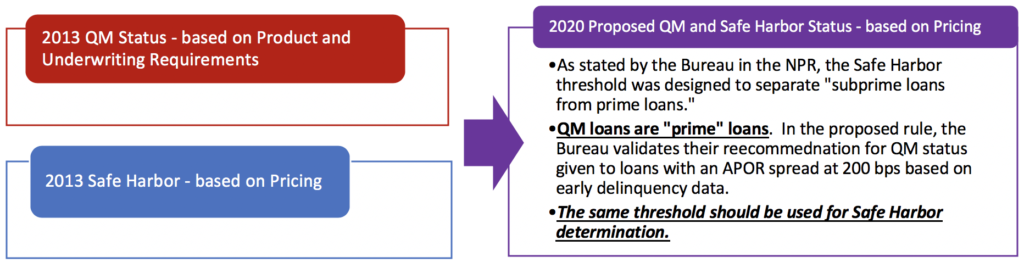
Going beyond HPML to address some of the underwriting concerns in the marketplace, Dodd-Frank created specific mortgage product restrictions and required the CFPB to promulgate a rule defining Qualified Mortgage based on specific underwriting criteria. As promulgated in the 2013 final rule, QM and safe harbor were measuring two separate things so different standards made a certain amount of sense. The QM standard was based on product and underwriting requirements, while safe harbor was based on loan pricing specifically assessing whether the loan was a HPML.

The CFPB is now seeking to update the regulation. In late June, the Bureau issued Notices of Proposed Rulemaking (NPRM) on the general QM definition under the Truth in Lending Act (Regulation Z) and the GSE Patch. The CFPB proposes to change the current QM standard in favor of a pricing threshold based on the difference between the loan’s annual percentage rate (APR) and the average prime offer rate (APOR) for a comparable transaction. The proposed rule would define a QM as a mortgage loan which is priced not more than 200 basis points (bps) above the APOR.

Unlike the 2013 final rule, the QM standard and safe harbor are measured using the same price metric under the new proposed rule. Having two different pricing thresholds to determine QM and safe harbor loan status creates an unlevel playing field that will arbitrarily shift borrowers to mortgages backed by the Federal Housing Administration (FHA) and leave consumers with less access to mortgage finance credit—all based on an arbitrary line.[1]

While USMI will comment on other aspects of the proposed rule, we think that one of the most significant issues within the proposal is the safe harbor pricing threshold. Based on our analysis of mortgage originations, loan performance, market dynamics, and the need to ensure consumer access to affordable mortgage finance, we recommend that this threshold should be pegged to the same threshold as the QM status, which the NPR suggests should be 200 bps. USMI made this recommendation to the CFPB in a September 2019 comment letter in response the CFPB’s Advance NPRM.

In the 2020 proposed rule, the Bureau justifies recommending QM status be based on a pricing threshold to 200 bps using early delinquency data as an indicator of determining a borrower’s ATR, stating in the NPRM:

“…the Bureau tentatively concludes that this threshold would strike an appropriate balance between ensuring that loans receiving QM status may be presumed to comply with the ATR provisions and ensuring that access to responsible, affordable mortgage credit remains available to consumers.”[2]

Should the CFPB move forward to replace the current QM definition with one based on a pricing threshold, then the Bureau can and should increase the spread that is used to delineate safe harbor loans from 150 to 200 bps over APOR to be consistent with the threshold that the Bureau recommends for QM status in its NPRM.

Why moving the safe harbor threshold to 200 bps matters:

  • Lenders don’t lend above the safe harbor line in the conventional market.The distinction between safe harbor and rebuttable presumption matters. Market data makes it clear that many lenders avoid making rebuttable presumption QM loans to avoid any risk of legal liability. This is evidenced by the fact that less than five percent of all the conventional market financing in 2019 was done above the safe harbor line. For all intents and purposes, the safe harbor line effectively defines the conventional market and changes to how the Bureau defines QM safe harbor will impact who the conventional market will serve going forward.
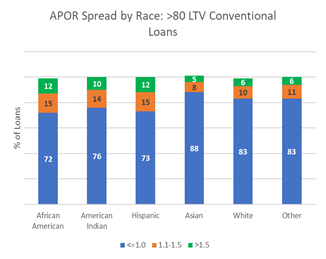
  • Current recommended threshold disproportionately impacts Black and Latinx borrowers who are twice as likely as White borrowers to have conventional low down payment purchase loans outside a safe harbor of 150 bps. Under the proposed rule, many of the borrowers who are above the 150 bps threshold will be left only with the option of a FHA loan, which means they have vastly different competitive choices in terms of product offerings and loan terms—as demonstrated by the fact that there were approximately 3,200 HMDA reporting lenders for conventional purchase loans versus only about 1,200 for FHA purchase loans. This arbitrary line affects these borrowers’ credit options and leaves them with significantly fewer competitive options in the marketplace.[3]
  • Creates an unlevel playing field. While the percentage of the conventional market above 150 bps is small on a percentage basis, this is not to suggest that there are not good quality loans above this threshold being done. FHA is five times more likely to have loans above the 150 bps simply because FHA calculates the APOR cap and APR calculation differently. HUD defines safe harbor as 115 bps plus the mortgage insurance premium, which is closer to FHA having a safe harbor threshold of approximately 200 bps, or even higher. Due to the discrepancies for how this threshold is calculated between the conventional and FHA markets, leaving the safe harbor threshold for conventional loans at 150 bps will arbitrarily distort the market and shift borrowers to FHA. This will give these borrowers fewer choices and shift borrowers from a market backed by private capital to the 100 percent taxpayer-backed market.

The Solution:

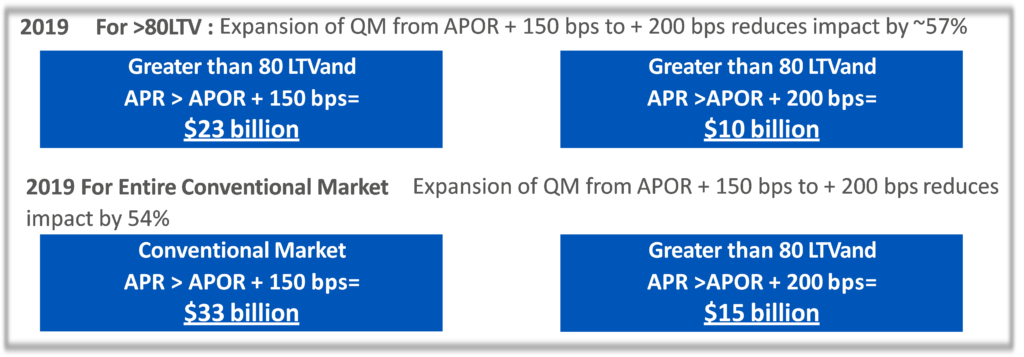
The solution is to increase the safe harbor pricing threshold to 200 bps to be consistent with the proposed QM pricing threshold. This will result not only in a more level playing field, but most importantly, by changing the threshold, the impact to borrowers can be mitigated. The volume of loans that would otherwise be left out of the conventional safe harbor market is reduced by almost 60 percent for the high-LTV market and reduced by over 50 percent for the entire conventional market.[4]

Increasing the safe harbor threshold to 200 bps above APOR will best ensure that we strike an appropriate balance between prudent underwriting, credit risk management, and consumers’ access to sustainable and affordable mortgage credit.


[1] 85 Fed. Reg. 41716 (July 10, 2020).

[2] 85 Fed. Reg. 41735 (July 10, 2020). Underlying and emphasis added.

[3] 2019 HMDA Data.

[4] 2019 HMDA Data.

Press Release: Private Mortgage Insurers Transfer Nearly $34 Billion in Risk on Nearly $1.3 Trillion of Insurance-in-Force from 2015-2019

USMI releases details on the developments and growth of private mortgage insurance credit risk transfer

WASHINGTON — U.S. Mortgage Insurers (USMI) today announced that private mortgage insurance (MI) companies transferred nearly $34 billion in risk on nearly $1.3 trillion of insurance-in-force from 2015 to 2019. USMI released details on the developments and growth of the MI credit risk transfer (MI CRT) market, which outlines the types of structures being used by the industry to transfer risk to reduce volatility and exposure of mortgage credit risk within the mortgage finance system, including to the government sponsored-enterprises (GSEs), and therefore taxpayers. It also finds that active adoption of CRT by private mortgage insurers has transformed the industry to help better insulate it from the cyclical mortgage market and enhanced their ability to be more stable, long-term managers and distributors of risk.

“Through innovative new MI CRT structures, the industry is taking additional steps to enhance MI resiliency and the risk protection provided to the conventional mortgage market. MI CRT demonstrates that MI companies are sophisticated experts in pricing and actively managing mortgage credit risk,” said Lindsey Johnson, President of USMI. “Private MI plays a critical function in the housing finance system by serving as the first layer of protection against mortgage defaults. MI is also one of the only sources of private capital that has been available through all market cycles. After the financial crisis, the MI industry improved its safety and soundness through enhanced capital and operational standards, which in turn made us more resilient to withstand severe economic stress.”

USMI examined the two main MI CRT structures: Reinsurance and Capital Markets. It found that mortgage insurers have executed 18 reinsurance deals since 2015, transferring over $25 billion of risk on over $530 billion of insurance-in-force. As for the Capital Markets structure, the industry introduced MI Insurance Linked Note (ILN) programs beginning in 2015. Since then, mortgage insurers have issued 19 ILN deals, transferring $7.8 billion of risk on over $730 billion ofinsurance-in-force.

“While the MI industry has distributed credit risk for decades, these innovative CRT structures adopted by the industry in 2015 have transformed it from a ‘buy-and-hold’ into an ‘aggregate-manage-and-distribute’ model,” said Johnson. “The financial risk management approach of private MI companies has become much more countercyclical and significantly benefits the housing finance system.”

Because private mortgage insurers typically hold a portion of the first loss there is an alignment of incentives that ensures quality underwriting continues to be done by the industry, which reduces investors’ risk exposure, and ensures quality control on risk for investors and within the broader financial system. The investor base in these transactions continues to grow exponentially as the frequency of transactions increases, and the MI CRT investors to date represent trillions of dollars of private capital under management that provides a stable, deep pool of liquidity for the market.

“The MI CRT structures underscore the resilient nature and benefits of MI and the private capital it supplies to the housing market, safeguarding taxpayers against mortgage defaults, and ensuring that the private MI industry will continue to play a vital role in the mortgage finance system,” added Johnson.

More information on MI CRT is available here.


###

U.S. Mortgage Insurers (USMI) is dedicated to a housing finance system backed by private capital that enables access to housing finance for borrowers while protecting taxpayers. Mortgage insurance offers an effective way to make mortgage credit available to more people. USMI is ready to help build the future of homeownership.

Newsletter: September 2019

Congress is back from recess, Pumpkin Spice lattes are back on the menu, and housing finance reform is back at the top of news headlines in Washington this fall. In September, the Trump Administration released plans to reform the nation’s housing finance system. USMI issued a statement applauding the initiative and calling for Congress to address the GSEs’ underlying structural challenges and promote a coordinated federal housing policy. The Senate Banking Committee also held a hearing on the matter to learn more about the Administration’s Plans. The same week that the Administration released its Plans, the Fifth Circuit ruled in favor of GSE shareholders in their lawsuit against the U.S. Treasury, as the court allowed the shareholders to reinstate claims alleging that FHFA is unconstitutionally structured. While the fate of the legal challenges is still unclear, what is clear is that FHFA is moving ahead on many of its plans to review and make changes to the current programs and activities of the GSEs. Last week, FHFA announced an increase to the caps on the amount of multifamily loans the GSEs can purchase next year, and just this week FHFA announced an end to the GSEs’ pilots to offer lines of credits to non-bank servicers that pledge agency mortgage servicing rights (MSRs) as collateral. Additionally, the CFPB closed its comment period on its Advance Notice of Proposed Rulemaking (ANPR) this week on the “Qualified Mortgage Definition under the Truth in Lending Act.” USMI submitted comments outlining several recommendations to the Bureau to balance prudent underwriting with consumers’ access to mortgage finance credit. Lastly, the House Financial Services Committee held a markup on several housing related bills, including legislation to reauthorize the HUD to implement credit scoring pilots in the underwriting process for FHA insured mortgages.

  • The Trump Administration’s Housing Finance Reform Plans. On September 6, the U.S. Treasury Department and the U.S. Department of Housing and Urban Development (HUD) released their comprehensive Housing Reform Plan and Housing Finance Reform Plan to end the federal conservatorships of the government sponsored enterprises (GSEs), which have lasted more than 11 years. USMI released a statement that applauds Treasury and HUD for their comprehensive plans and calls for Congress to address the underlying structural challenges of the GSEs. USMI wrote, “the Administration’s proposals to reduce taxpayer risk exposure and address the areas of misaligned incentives of the GSEs while increasing transparency and market discipline could be the catalyst to break the legislative logjam and enable policymakers to enact comprehensive reforms.” USMI also appreciates that Treasury and HUD identified specific areas where the Administration can focus its efforts to put the housing finance system on a more sustainable path. Many of the actions proposed by the Administration’s Plans align with USMI’s principles for Administrative Reform, including increasing transparency in the housing finance system and expanding the role of private capital ahead of taxpayer risk.
  • Senate Banking Committee Hearing. After the release of the Administration’s Plans, the U.S. Senate Committee on Banking, Housing, and Urban Affairs held a hearing on September 10 titled “Housing Finance Reform: Next Steps,” in which HUD Secretary Ben Carson, Treasury Secretary Steve Mnuchin, and Federal Housing Finance Agency (FHFA) Director, Mark Calabria, delivered their testimonies and answered questions from committee members.

    All three Administration officials reiterated the need for Congress to provide input on reform, inviting the Legislative Branch to take a leadership role. Treasury Secretary Mnuchin said, “[p]ending legislation, Treasury will continue to support FHFA’s administrative actions to enhance the regulation of the GSEs, promote private sector competition, and satisfy the preconditions set forth in the plan for ending the GSEs’ conservatorships.” FHFA Director Mark Calabria also noted that “[the GSEs] have expanded with the economy recently yet maintained risk and capital levels that ensure they will fail in a downturn. This pro-cyclical pattern harms low-income borrowers, making it easier to buy homes beyond their means when the economy is strong and harder to keep those homes when the economy is weak.”

    Chairman Crapo (R-ID) said in his opening statement that “[m]any of the legislative recommendations in the Plans that were released are consistent with my outline to fix our housing finance system, including attracting private capital back into the market; protecting taxpayers against future bailouts; and promoting competition.” Ranking Member Brown (D-OH) summarized the foundational principles for reform around which housing stakeholders are coalescing and added that “[w]e need a housing system built on a mission to serve borrowers and renters, no matter who they are, what kind of work they do, or where they live. That means we need policies that focus on increasing service for underserved markets, like rural areas and manufactured homeowners, and borrowers who have been locked out of the housing market over decades of discrimination.”

  • Fifth Circuit rules on FHFA. On September 9, the Fifth Circuit ruled in favor of investors suing the U.S. Treasury Department, allowing them to proceed with previously dismissed claims alleging the FHFA exceeded its authority with “net worth sweep.” “Congress created FHFA amid a dire financial calamity, but expedience does not license omnipotence,” U.S. Circuit Judge Don R. Willett wrote for a nine-member majority. “The shareholders plausibly allege that the Third Amendment exceeded FHFA’s conservator powers by transferring Fannie and Freddie’s future value to a single shareholder, Treasury.” The case will now be discussed in a Texas federal court where it was originally filed in 2016. The court will decide whether the restored investor claims should go to trial or be resolved on summary judgement.
     
  • FHFA increases GSEs multifamily lending caps and ends GSE MSR Pilot Program. On September 16, the FHFA increased caps on the amount of multifamily loans the GSEs can purchase next year. FHFA will now limit Fannie Mae and Freddie Mac to purchasing over $100 billion each -up from $35 billion each in the years 2018 and 2019- in multifamily-housing residential loans, between the fourth quarters of 2019 and 2020. FHFA also made other revisions to how the GSEs can conduct their multifamily businesses, now requiring that the two firms must have over one-third (37.5 percent) of their multifamily activities directed toward affordable housing. Furthermore, the new lending caps eliminate exclusions that allowed the GSEs to purchase loans in excess of the limits previously in place.

    “Multifamily housing is a critical component of addressing our nation’s shortage of affordable housing,” said FHFA Director Mark Calabria. “These new multifamily caps eliminate loopholes, provide ample support for the market without crowding out private capital, and significantly increase affordable housing support over previous levels. The Enterprises should also manage under the caps to provide consistent, stable liquidity to the market throughout the entire five-quarter period.” 

    Earlier this week, FHFA announced an end to the GSEs’ pilot program to finance MSRs. It was reported on May 7, that Freddie Mac had provided lines of credit for several nonbank servicers. In making the announcement, Director Calabria noted “[t]he MSR market is already served by a wide assortment of highly competitive private sources of capital and financing. Going forward, the Enterprises should focus on activities that are core to the guaranty business, mitigate risk, and are essential to end the conservatorships.”

  • CFPB closes comment period on QM definition. On September 16, the Consumer Financial Protection Bureau (CFPB) closed its comment period on its ANPR on the “Qualified Mortgage (QM) Definition under the Truth in Lending Act,” in light of the pending expiration of the provision commonly referred to as the “GSE Patch” in January 2021. USMI applauded the CFPB’s initiative of undertaking an assessment of this critical rule. It submitted a comment letter offering specific recommendations for replacing the current “GSE Patch” to establish a single transparent and consistent QM definition in a way to balance access to mortgage finance credit and proper underwriting guardrails to ensure consumers’ ability-to-repay (ATR). USMI’s recommendations include:

    • Maintaining the ATR and product restrictions as part of any updates to the QM definition to ensure discipline in the lending community and to protect consumers;
    • Retaining specific underwriting guardrails such as a debt-to-income (DTI) threshold but notes that DTI should not be a stand alone factor for ATR. Further, the USMI comment letter demonstrates through data that the DTI threshold should be adjusted to better serve consumers;
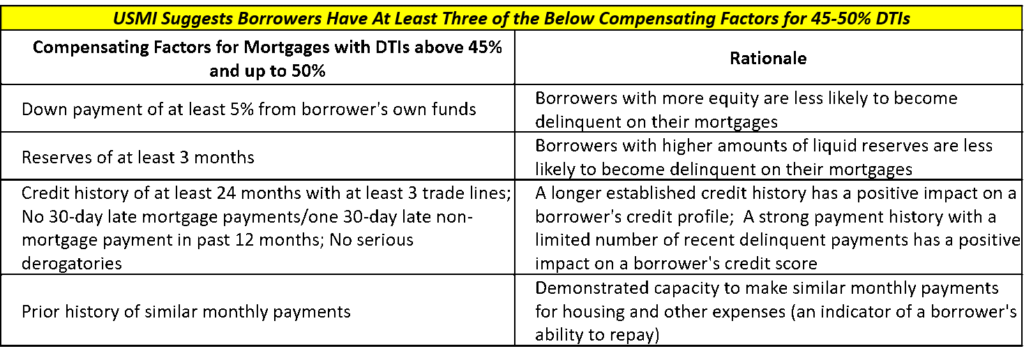
    • Because DTI should not be a stand along measure of ATR, USMI recommends developing a single set of transparent compensating factors for loans with DTIs above 45 and up to 50 percent for defining QM across all markets, similar to how the GSEs, FHA, and VA use compensating factors in their respective markets today.

      Importantly, nine Democratic U.S. Senators led by Senate Banking Ranking member Sherrod Brown sent a letter to the Bureau stating that as it considered amending the existing QM rule, the Bureau “must not undermine the elements of the rule that have made it effective: prohibitions on unsustainable product features and a verifiable demonstration at loan origination that the lender has evaluated the borrower’s ability to repay their loan.”

      Other associations and entities such as the National Association of Hispanic Real Estate Professionals (NAHREP), National Association of Home Builders, Digital Federal Credit Union, National Association of Federally-Insured Credit Unions (NAFCU), CNB Bank, International Bancshares Corporation, Wisconsin Credit Union League, Highlands Residential Mortgage, among others, share similar views as USMI that setting transparent compensating factors will help expand credit availability for many potential homeowners who may otherwise be left behind.

  • House Financial Services Committee Markup. On September 18-20, the U.S. House of Representatives Committee on Financial Services, held a markup hearing in which, along with several issues, they discussed H.R. 123, the “Alternative Data for Additional Credit FHA Pilot Program Reauthorization Act,” and reported the legislation favorably to the House with a 32-22 vote. This bill would reauthorize the HUD statutory authority to implement a pilot program to increase credit access for borrowers with thin or no credit files through the use of additional credit data in the underwriting for FHA-insured mortgages.

Newsletter: August 2019

As the August recess begins, there have been several notable developments in housing finance. Last Thursday, the Consumer Financial Protection Bureau (CFPB) released its Advanced Notice of Proposed Rulemaking on the “Qualified Mortgage (QM) Definition under the Truth in Lending Act” which seeks to revise the QM definition as the GSE Patch nears expiration. Moody’s Investor Service released a proposed update to its residential mortgage-backed security (RMBS) rating methodology which would affect the rating for bonds associated with the GSEs’ CRT transactions and non-agency RMBS. Importantly, the new standard recognizes the loss reducing benefits of private mortgage insurance (MI). The Urban Institute published an article highlighting private MI and the benefits of reducing the severity of losses for those holding mortgage credit risk.

Also, on the regulatory front, as many financial institutions look to implement the Financial Accounting Standards Board’s (FASB) Current Expected Credit Loss (CECL) accounting standard, FASB has announced proposed changes, including delaying the implementation deadline for private companies as well as small public companies. USMI released an update on the treatment of loan level credit enhancement provided under the CECL standard, providing information to lenders of all sizes on how they might mitigate loss reserve requirements under the new standard. Housing finance reform continues to gain attention in recent weeks with Federal Housing Finance Agency (FHFA) Director Mark Calabria recently giving an update on the timing of the release of the Administration’s plans to reform the housing finance system. Lastly, there have been a number of studies and reports in recent weeks that continue to cite consumers’ misperception that they need a large down payment to qualify for homeownership. USMI published a new column that highlights low down payment mortgage options available to help home-ready borrowers attain sustainable homeownership sooner.

  • CFPB’s ANPR on Qualified Mortgages. On July 25, the CFPB released an Advanced Notice of Proposed Rulemaking on the “Qualified Mortgage Definition under the Truth in Lending Act.” The CFPB is considering whether to revise the QM definition in light of the pending expiration of the Temporary GSE QM loan category provision, commonly referred to as the “GSE Patch,” in January 2021. The same statutory product restrictions exist for loans under the Patch as for other QM loans, however these loans are not subject to the 43 percent debt-to-income (DTI) limit—a significant exception that has supported a substantial portion of the overall housing market. As takers of first-loss mortgage credit risk with more than six decades of expertise and experience underwriting and actively managing that risk, USMI members understand the need to balance prudent underwriting using a clear and transparent standard to ensure sustainable lending with the need to maintain access to affordable mortgage finance credit for home-ready borrowers. Following the release of the ANPR, USMI published a blog with observations and recommendations for replacing the GSE Patch.

  • Moody’s releases proposed update to RMBS ratings. Moody’s recently released a proposed update to its RMBS rating methodology which would affect the rating for bonds associated with the GSEs’ CRT transactions and non-agency RMBS. Importantly, the new standard gives more credit to deals with private MI. USMI submitted a letter on July 29 to Moody’s in response to request for comment by Moody’s on the new standard, which among other things commends Moody’s for many of the necessary updates provided in the proposed standard and asks for additional transparency around details about the benefits of MI, the proposed rejection rates, and Moody’s methodology for determining maximum insurance payout and allocation based on an insurer’s rating.

  • Urban Institute publishes article on risk reducing benefits of PMI. Urban Institute released a paper entitled, “Private Mortgage Insurance Reduces the Severity of Losses for Those Holding Risk,” that focuses on Moody’s recent proposed updates to its RMBS rating methodology, which will affect the ratings of bonds for the GSEs’ CRT deals and non-agency RMBS, and would give more credit to deals with MI. In the report, Urban notes, “given the increased focus on the topic, understanding the historical behavior of GSE loans with mortgage insurance is important. Examining Fannie Mae loans from 1999 through the first quarter of 2018, we conclude that PMI reduces the loss severity of loans with high loan-to-value (LTV) ratios by 19 to 24 percentage points—a very substantial reduction. So, it is important to recognize PMI’s contribution when developing measures assessing loan-level risk, giving proper “credit” in sizing capital requirements or assessing subordination levels for securitizations.”

  • Current Expected Credit Loss (CECL) accounting standard. Over the last couple of weeks, FASB has announced several proposed changes for the CECL accounting standard, including delaying the implementation deadline for private companies as well as small public companies (those with a market capitalization below $250 million and annual revenue of less than $100 million). If that proposal is enacted, the standard for those companies would not take effect until January 2023. CECL is a fundamental shift in how loss reserves are accounted for and incurred. Instead of waiting until losses are probable, institutions will forecast losses and establish reserves at the time of origination. The final rule was announced on June 16, 2016 and will impact any financial institution that holds loans on its balance sheet at amortized cost, such as banks, credit unions, and real estate investment trusts (REITs). Public companies filing with the Securities and Exchange Commission (SEC) will need to adopt CECL for fiscal years beginning after December 15, 2019, including interim periods within those fiscal years.

    As noted by the Government Accountability Office (GAO), “CECL is considered by some to be the most significant accounting change in the banking industry in 40 years.” Banking regulators – the Federal Deposit Insurance Corporation (FDIC), Federal Reserve, and Office of the Comptroller of the Currency (OCC) – jointly issued a final rule on CECL’s implementation and have proposed changing the allowance for home and lease losses as a new defined term.

    Ahead of the implementation, and as lenders look to prepare as the implementation deadline approaches, USMI published a fact sheet on their website to provide information to lenders about the potential impact CECL may have on their books of business and how loan level credit enhancement, such as private MI, can help offset loss reserve requirements.

  • FHFA Director gives update on the Administration’s GSE plan. In March President Trump signed an Executive Order that directed federal agencies, most notably the Treasury Department and the Department of Housing and Urban Development, to provide both administrative and legislative solutions for modernizing the housing finance system and ending the conservatorships of the GSEs. Recently in an interview with Reuters, FHFA Director Mark Calabria said that he now expects the Administration will release reports developed by the Departments of Treasury and of Housing and Urban Development that outline the Administration’s plan for releasing Fannie Mae and Freddie Mac from conservatorship to be published at the end of August or early September

    Last fall, USMI released a white paper highlighting several areas of alignment around administrative reform that can be implemented in lieu of comprehensive legislative action by Congress. The specific recommendations proposed by USMI include reducing the duopolistic market power of the GSEs, increasing transparency, expanding private capital and reducing taxpayer risk, and promoting a strong regulator that establishes uniform standards and uses transparent processes to assess the GSEs activities and products.
  • USMI publishes new column on low down payment options. Earlier this month, USMI published a new column, “Buy a home without breaking the bank.” The column highlights the several solutions available to financial obstacles that may arise when buying a home, such as the 20 percent down payment. According to a recent report, 49 percent of non-homeowners stated that not having enough money for a down payment and closing costs was a major obstacle to purchasing a home. But data shows many aspiring homebuyers can afford to buy a home with less than 20 percent. Another survey found that among first-time homebuyers who obtained a mortgage, approximately 80 percent had down payments of less than 20 percent. The article links readers to LowDownPaymentFacts.com where consumers can learn about the number of different low down payment mortgage options available to them and how to become “home-ready.”

###

U.S. Mortgage Insurers (USMI) is dedicated to a housing finance system backed by private capital that enables access to housing finance for borrowers while protecting taxpayers. Mortgage insurance offers an effective way to make mortgage credit available to more people. USMI is ready to help build the future of homeownership. Learn more at www.usmi.org.

Blog: MI Industry’s Observations & Recommendations for Replacing CFPB’s QM Patch

The Consumer Financial Protection Bureau (CFPB) just released an Advanced Notice of Proposed Rulemaking on the “Qualified Mortgage Definition under the Truth in Lending Act.” The CFPB is considering whether to revise the Qualified Mortgage (QM) definition in light of the pending expiration of the provision commonly referred to as the GSE Patch (or Temporary GSE QM loan category) in January 2021. The same statutory product restrictions exist for loans under the Patch as for other QM loans, however these loans are not subject to the 43 percent debt-to-income (DTI) limit—a significant exception that has supported a substantial portion of the overall housing market. Considering a robust market has developed under the GSE Patch, any changes could substantially impact consumers’ access to mortgage finance as well as determine the level of risk within the mortgage finance system, which has implications for homeowners, financial institutions, and taxpayers.

As takers of first-loss mortgage credit risk with more than six decades of expertise and experience underwriting and actively managing that risk, USMI members understand the need to balance prudent underwriting with the need to ensure there is a clear and transparent standard that maintains access to affordable and sustainable mortgage finance credit for home-ready borrowers. As different stakeholders contemplate what to do next with the Patch, USMI offers a few observations and recommendations for replacing the QM Patch.

Observations 

DTI is not the best or most predictive factor in assessing consumers’ ability-to-repay. Pre-financial crisis, one of the most egregious lending practices was making loans to individuals without a reasonable consideration of their financial ability-to-repay (ATR) the loan. As policymakers and regulators aimed to ensure consumers had at least some reasonable ATR their mortgages going forward, the 43 percent DTI cap was established as part of the CFPB’s QM rule. While DTI is not necessarily the most predictive measure, historical data (especially for 2004-2007 cohorts of loans) demonstrates that higher DTIs are correlated to higher defaults (and predictive of a consumer’s ATR).[i] Yet, DTI is only one measure.

USMI and others have identified more predictive borrower characteristics, most notably that reserves in a bank account are more indicative of an individual’s ATR than many other factors. According to a recent report by JPMorgan Chase Institute,[ii] when a borrower has three months of reserves (funds to cover mortgage payments) in the bank, these borrowers were five times less likely to default on their mortgage as those who had insufficient cash in the bank to cover one mortgage payment. According to the JPMorgan Chase Institute report, homeowners who had less than one month’s mortgage payment in savings made up 20 percent of the people in their survey but made up 54 percent of the people in the survey who defaulted on their loans.

While DTI is one factor for assessing ATR, by simply limiting the market to a hard 43 percent limit, many home-ready borrowers will be cut out of the market. In fact, roughly 30 percent of the GSEs’ market today is above the 43 percent DTI limit. CoreLogic estimates that the total loan origination volume for 2018 for loans that were above the 43 percent limit was roughly $260 billion out of a $1.6 trillion market in 2018[iii] (though this number could be higher because some banks have chosen to hold loans in their portfolio that are above the 43 percent DTI limit).

The need for transparency and input on compensating factors. Since the implementation of the QM Rule and the GSE Patch, the market has seen that many good quality loans have been above the 43 percent DTI limit. For loans with higher DTI under the Patch, the market has adapted and relied on compensating factors to adjust for and mitigate the additional risk. These compensating factors are done as part of the GSEs’ automated underwriting systems (AUSs). The current AUSs and the compensating factors used within them are not transparent to stakeholders or the public. However, as mortgage insurers and others analyze GSE loans with higher DTIs, we can begin to back-in to what the compensating factors are and when they come into play for higher DTI GSE loans.

Recommendations

ATR and product restrictions should remain as part of any updates to the QM rule. USMI believes the requirements for assessing a borrower’s ATR that require the lender to underwrite the consumer using credit, income and asset documentation should remain as critical components to any enhancements to the rule. It is also essential that the QM statutory product restrictions remain intact to maintain discipline in the lending community as well as to protect consumers.

A single, transparent underwriting standard for defining QM criteria should be established. USMI recommends a list of transparent mitigating underwriting criteria (compensating factors) for loans with DTIs between 45 and 50 percent for defining QM (in addition to the existing statutorily defined product features and ATR underwriting criteria) be established. While USMI has developed a list of proposed criteria (see below), the list of criteria could ultimately be set by a non-profit membership organization or standard-setting body.

A transparent and easy-to-understand and use set of underwriting criteria can be programmed to allow for manual underwriting or automatic underwriting engines. Further, any private market participant could publish or code these criteria in their investor requirements. For the GSEs, it would remain in the purview of the Federal Housing Finance Agency (FHFA) Director to determine whether the GSEs could guarantee high DTI loans. If not, the loans would simply receive an “Approve/Ineligible” or “Accept/Ineligible” AUS decision. This approach would level the playing field between market participants, allow for continued innovation around documentation, verification, and other underwriting standards, and force the GSEs’ AUSs to become more transparent.

Proposed Set of Compensating Factors

Importantly, USMI believes that there should be one industry standard with complete transparency into the credit decisioning factors used for underwriting mortgage credit risk and that input from industry should be allowed on updates to the underwriting criteria. Further, any changes related to maximum DTIs should be consistent across different lending channels (e.g., FHA and GSEs) to ensure there is not market arbitrage to achieve QM status.

Appendix Q needs to be addressed. All proposals to assess and define an ATR will have challenges or shortcomings. For any proposal that includes DTI, there is still the challenge of addressing the acknowledged limitations of Appendix Q, including to allow lenders to document and verify borrower income and assets utilizing new innovations in the industry. A possible permanent fix to address Appendix Q could be to allow for the GSEs’ guides to be maintained by a regulatory body outside of the GSEs and updated as necessary. Legislation is needed if Appendix Q is to allow for the use of guides or handbooks of the GSEs or other agencies.

APOR could remain the determinant for the Safe Harbor protection but should not be the replacement for DTI requirement and Underwriting Criteria. Further, to provide a more level playing field between the Federal Housing Administration (FHA) and the conventional market, the annual percentage rate (APR) cap of Average Prime Offer Rate (APOR) + 150 bps needs to be increased to account for GSE LLPAs and private mortgage insurance. Setting the cap for QM Safe Harbor protection at 200 bps over APOR + 200 bps will limit the shift of riskier, high-LTV business to FHA, preserve greater private capital participation in the pricing of risk, and promote better taxpayer protection.


[i] https://www.fhfa.gov/PolicyProgramsResearch/Research/Pages/wp1902.aspx

[ii] JPMorgan Chase Institute: Trading Equity for Liquidity: Bank Data on the Relationship Between Liquidity and Mortgage Default. June 2019.

[iii] https://www.corelogic.com/blog/2019/07/expiration-of-the-cfpbs-qualified-mortgage-gse-patch-part-1.aspx

Blog: Buy a Home Without Breaking the Bank

Buying a home is one of life’s biggest financial milestones, but people often think it’s out of reach because of the costs involved, including the myth that you have to put 20% down. The fact is, you don’t necessarily need to deplete all of your savings to qualify for a mortgage and you can purchase a home sooner than many people believe.

You aren’t alone in thinking you can’t afford a home right now. According to a recent report, 49% of non-homeowners stated that not having enough money for a down payment and closing costs was a major obstacle to purchasing a home. But when you look at the data, many aspiring homebuyers can afford to buy a home with less than 20%. In fact, another recent survey found that among first-time homebuyers who obtained a mortgage, approximately 80% had down payments of less than 20%.

There are several low down payment mortgage options available to you, such as conventional loans with private mortgage insurance (MI) or government-backed loans like those insured by the Federal Housing Administration (FHA).

For example, a qualified borrower can get a conventional loan with private MI for as little as 3% down. If he or she waited to save for a 20% down payment, it could take up to 20 years to save that amount, plus closing costs, for a $262,250 house — the national median sales price in 2018 according to the National Association of REALTORS®.  That wait time is trimmed down to seven years when buying a home with a 5% down, where the loan is sustainably backed by private MI.  Purchasing a home with less down using private MI can also help ensure you continue to have prudent savings, and can free up funds that you can use for other important home purchases – such as renovations, appliances, and furniture.

There are other mortgage options available to you as well, such as government-backed FHA loans that allow you to put down as little as 3.5%. However, unlike private MI, which can be canceled once you reach 20% equity in your home, the mortgage insurance premiums attached to FHA loans typically can’t be canceled and remain throughout the life of the loan.

It’s important to know what home loan option is best for you, and you should speak with a mortgage lender to help inform your decision. The bottom line, however, is that there are affordable low down payment home loan options out there, which could mean the difference between getting into your home sooner, allowing you to build wealth through home equity, or waiting for years while renting. By taking advantage of home loans backed by private MI, you can spend less time worrying about a down payment and more time enjoying your new home.

Getting into your new home with private MI and keeping more of your hard-earned money in the bank can be a very smart way to invest in your future. Check out www.LowDownPaymentFacts.com to learn more.

Newsletter: June 2019

Washington is buzzing with activity on the housing finance front, both in market developments and policy discussions as FHFA Director Calabria continues to outline his plans for Fannie Mae and Freddie Mac (“the GSEs”).
 
Also, June is National Homeownership Month! On June 5, USMI released a new report on how private mortgage insurance (MI) helps borrowers get into homes sooner. Brad Shuster, USMI Chairman and Executive Chairman of the Board of NMI Holdings, Inc., penned an op-ed in The Hill highlighting some key points from the report. In addition, the Federal Housing Finance Agency (FHFA) finalized their Single Security Initiative to create a common single-family securities program for the GSEs after the launch of the Uniform Mortgage-Backed Security (UMBS). Fannie Mae published the results of a nationally representative survey that revealed most consumers overestimate the requirements to get a mortgage. Lastly, the Senate confirmed two key positions for the U.S. Department of Housing and Urban Development (HUD) and the Senate Banking Committee scheduled a hearing entitled “Should Fannie Mae and Freddie Mac be Designated as Systemically Important Financial Institutions (SIFIs)?”

  • USMI releases state-by-state report on role of private MI. USMI released its second annual report on the role of private MI facilitating low down payment lending in all 50 states and the District of Columbia. The report found more than 30 million homeowners have been served by MI since 1957, including more than one million people in 2018 alone, and breaks down on a state-by-state basis, low down payment mortgage lending with private MI. It also provides an analysis of how long it would take those borrowers to save for a 20 percent versus a five percent down payment. The report finds that the top five states for the number of borrowers helped by private MI in 2018 were Texas, Florida, California, Illinois, and Ohio. The complete report on MI in the U.S. is available here.
  • Brad Shuster, USMI Chairman and Executive Chairman of the Board of NMI Holdings, Inc, penned an op-ed in The Hill. Shuster celebrated National Homeownership Month with an op-ed in The Hill that highlights the national conversation about how to best reform the U.S. housing finance system to sustain and grow homeownership in a safe and affordable way. Importantly, Shuster highlights the very important role that private MI plays in ensuring home-ready borrowers have access to sustainable low-down payment lending. Mr. Shuster notes that the recently released USMI state-by-state report, “showcases how private MI helps hard-working, home-ready families access the conventional mortgage market, even when they don’t have a large down payment.”

    Shuster also notes the importance for policymakers to understand the “long, time-tested role MI has played as they seek to create a more robust housing finance system. Private MI serves as protection against mortgage credit risk if a borrower defaults on their mortgage.”
  • FHFA sends Annual Report to Congress and Director Calabria calls for legislative reforms. Last week, FHFA sent its Annual Report to Congress, which included Director Calabria’s legislative recommendations for housing finance reform. In the FHFA 2018 Report to Congress, FHFA reported on a number of activities executed over the last year by the GSEs. While the report was drafted (and likely finalized) prior to Director Calabria’s confirmation (FHFA is required to submit the report each year before June 15), the Director wrote an opening letter to Chairman Mike Crapo (R-ID) and Ranking Member Sherrod Brown (D-OH) to reiterate his priorities for the GSEs. Director Calabria underscored the need for reform, stressing that taxpayers remain exposed to undue mortgage credit risk and to urge Congress to enact legislation.

    In the letter, Director Calabria outlined specific recommendations for legislative reforms, including a request for Congress to give him authority to grant new charters to increase competition against the GSEs’ “duopoly” suggesting, “[t]o promote competition, Congress should authorize additional competitors and provide FHFA chartering authority similar to that of the Office of the Comptroller of the Currency.” He also called for Congress to grant FHFA additional authority to provide oversight of counterparties and suggested that FHFA should have greater discretion over the GSEs’ regulatory capital. While Director Calabria has noted in public speeches that only Congress has the authority to provide for an explicit government guaranty, he did not specifically call for Congress to establish an explicit government guaranty in his letter.
  • The GSEs complete their Single Security Initiative and launch UMBS. Earlier this month, Fannie Mae and Freddie Mac officially moved to issue the Uniform Mortgage-Backed Security (UMBS). According to HousingWire, the UMBS is a common security through which the GSEs will finance qualifying fixed-rate mortgage loans backed by one- to four-unit single-family properties. Previously, the GSEs only issued securities through their own programs/platforms, which meant an inevitable disparity and inconsistencies existed between the two. Fannie Mae’s program has historically been far more liquid than Freddie Mac’s, which created an imbalance between their trading volumes. Under the new initiative, FHFA will require Freddie Mac to remit homeowners’ mortgage payments to investors in 55 days rather than 45, which is consistent with Fannie Mae’s guidelines.

    Following the launch, Renee Schultz, Senior Vice President of Capital Markets at Fannie Mae, released a statement calling the launch “a major milestone that marks the successful implementation of the Single Security Initiative.” FHFA Deputy Director Robert Fishman stated, “[b]y addressing structural issues and trading disparities, the UMBS will benefit taxpayers and the nation’s housing finance system.”
  • Fannie Mae consumer survey finds knowledge gap to obtain a mortgage. On June 5, Fannie Mae published the results of a survey of 3,647 Americans which found that most consumers vastly overestimate the requirements to obtain a mortgage. “The lack of mortgage qualification understanding is pervasive, even among current homeowners, those who say they are actively planning to purchase a home in the next three years, and those who successfully answered questions testing general financial literacy,” the researchers wrote. For example, when asked how much money a borrower is required to put down, 40% said they didn’t know. Of those who did have an idea, they cited 10% as a required minimum.  
  • Senate Banking Focuses on the GSEs as SIFIs. The Senate Banking Committee has scheduled a hearing entitled “Should Fannie Mae and Freddie Mac be Designated as Systemically Important Financial Institutions?” The hearing is timely given FHFA Director Calabria has repeatedly said “the path out of conservatorships that we will establish for Fannie and Freddie is not going to be calendar dependent. It will be driven, first and foremost, by their ability to raise capital.” It also comes as policymakers and stakeholders wait for FHFA action following the agency’s Notice of Proposed Rulemaking on the Enterprise Capital Framework that was released last summer and for which the comment period closed in November 2018. USMI submitted a comment letter, which can be found here.
  • Senate confirms HUD nominees. Finally, yesterday, the Senate voted to confirm two HUD nominees: Seth Appleton to be the Assistant Secretary for Policy Development and Research; and Robert Hunter Kurtz to the be the Assistant Secretary for Public and Indian Housing.

Blog: New Report Shows Saving 20 Percent to Buy a Home Takes 20 Years on Average; Over 1 Million Avoided the Wait in 2018 by Using Private Mortgage Insurance

Texas, Florida, California, Illinois, and Ohio Round Out the Top Five States for Low Down Payment Mortgage Lending

WASHINGTON, June 5, 2019 — U.S. Mortgage Insurers (USMI), the association representing the nation’s leading private mortgage insurance (MI) companies, today released its annual report detailing low down payment insured mortgage lending in all 50 states and the District of Columbia. The report breaks down on a state-by-state basis low down payment mortgage lending with private MI, including the number of borrowers helped, the percentage of borrowers who were first-time homebuyers, average loan amounts, average FICO credit scores, and provides an analysis of how long it would take those borrowers to save for a 20 percent versus a five percent down payment.

“No, you do not need a 20 percent down payment to gain mortgage approval,” said Lindsey Johnson, President of USMI. “Our report underscores the critical role private MI plays in helping millions of first-time and middle-income homebuyers bridge the down payment gap across the United States. For over 60 years, private MI has helped provide Americans with affordable access to mortgage credit while also protecting taxpayers and the federal government from undue mortgage credit risk. Millions of borrowers have relied on private MI to responsibly purchase homes and MI will continue to facilitate the dream of homeownership going forward,” continued Johnson.

USMI finds that it could take 20 years for a household earning the national median income of $61,372 to save 20 percent (plus closing costs) for a $262,250 single-family home, the national median sales price. However, that wait time drops to seven years if the household purchases a home with a 5 percent down, where the loan is sustainably backed by private MI. This represents a 65 percent decrease in wait time at the national level, and USMI found the same percentage decrease at the state level.  

Since 1957, MI has helped more than 30 million families qualify for a mortgage. In 2018 alone, MI helped more than one million borrowers purchase or refinance a mortgage, nearly 60 percent of which were first-time homebuyers, and more than 40 percent had annual incomes below $75,000. The average loan amount purchased or refinanced with MI was $244,715 and the average FICO score for these borrowers was 741, compared to a 733 score for all home loan borrowers. The below table shows the top five states in which MI was used by borrowers to purchase or refinance homes in 2018.


State Number of Borrowers 
Helped with Private MI
First-Time 
Homebuyers
Texas 89,738 57 percent
Florida 77,565 56 percent
California 71,996 69 percent
Illinois 48,200 65 percent
Ohio 43,761 59 percent


In addition to the findings on how MI helps borrowers qualify for low down payment mortgages, the report also highlights the role MI plays in reducing the federal government’s, and therefore U.S. taxpayers’, exposure to mortgage credit risk. Private MI serves as credit protection against mortgage credit risk in the event a borrower defaults on his or her mortgage, meaning every dollar that an MI company covers when a borrower defaults on his or her mortgage is a dollar that the GSEs and taxpayers do not have to pay. In fact, since the 2008 financial crisis the MI industry has paid over $50 billion in claims – losses the government and taxpayers did not have to bear.

“The fact that private mortgage insurance has been helping Americans qualify for low down payment mortgages for more than six decades is a testament to the important access, stability, and credit protection the MI industry brings to the housing finance system,” added Johnson. “In recent years, the private MI industry has become even stronger with more robust underwriting standards, stronger capital requirements, and improved risk management. The industry is well-positioned to continue its important work, and we look forward to further helping grow American homeownership.”

The complete report on MI in the U.S. is available here, along with all 50 state fact sheets and data for the District of Columbia.

Statement: U.S. Senate’s Confirmation of Mark Calabria as New Director of Federal Housing Finance Agency

WASHINGTON Lindsey Johnson, President of U.S. Mortgage Insurers (USMI), today issued the following statement on the U.S. Senate’s confirmation of Dr. Mark Calabria as the Federal Housing Finance Agency (FHFA) Director:

“USMI applauds the Senate’s confirmation of Director Mark Calabria to serve as the next FHFA Director. Fannie Mae and Freddie Mac (the ‘GSEs’), the 11 Federal Home Loan Banks, market participants, and American homebuyers will be well-served under Director Calabria’s leadership at this critical time in the housing finance system.

“Director Calabria’s deep understanding of the mortgage finance system will be invaluable in promoting a more robust housing market that provides borrowers with access to affordable low down payment mortgage credit while simultaneously protecting taxpayers from undue mortgage credit risk. Director Calabria has long been an advocate for greater taxpayer protection against mortgage credit risk, including the use of private mortgage insurance (MI) to shield taxpayers and the federal government from financial risk on low down payment lending. We are confident that Director Calabria will continue to recognize the importance of private MI in the housing finance system.

“We look forward to working closely with Director Calabria to ensure that homebuyers continue to have affordable and prudent options for low down payment mortgage finance credit while also protecting taxpayers. For more than 60 years, private mortgage insurers have played a leading role in promoting affordable and sustainable homeownership and we look forward to building upon this important mission in the future.”

###

U.S. Mortgage Insurers (USMI) is dedicated to a housing finance system backed by private capital that enables access to housing finance for borrowers while protecting taxpayers. Mortgage insurance offers an effective way to make mortgage credit available to more people. USMI is ready to help build the future of homeownership. Learn more at www.usmi.org.