


How the Bank Capital Proposals Can Help Homebuyers Without Large Cash Down Payments

In March, bank regulators issued reproposed rules known as the Basel III Endgame, which seek to modernize the regulatory capital framework for banks and make them more risk-sensitive while preserving safety and soundness in the financial system. This will impact the amount of capital banks are required to hold against loans, including residential mortgages. Changes under consideration that may seem small on paper therefore could have big consequences for homebuyers. Today, private mortgage insurance (MI) is recognized by bank regulators as a factor for determining whether certain mortgages are prudently underwritten. Aligning this underwriting recognition – which supports safety and soundness – with the proposed capital rules may encourage banks to expand mortgage lending to homebuyers, and improve the availability and affordability of low down payment loans from banks of all sizes.
The full reproposed rules are complex and lengthy, so USMI is here to break down what it means for homebuyers and access to mortgage credit – and what changes to the final rules would further support affordable, sustainable homeownership.
What is the Basel III Endgame, and why should homebuyers care?
“Basel III” sounds like something that only matters to bankers in conference rooms, but it has real implications for the homebuying process. Bank capital rules require banks to set aside reserves in case loans default. The bigger and riskier the loan appears to be, the more of a financial cushion a bank has to hold when it makes that loan. In order to hold that cushion, banks may decide to pass on the cost in the form of higher mortgage rates, or in some cases, decide not to make certain loans at all.
How we got here
In 2023, U.S. regulators proposed a rule that would have significantly increased the capital required to be held against most residential mortgages, including low down payment loans. These low down payment loans are often protected by private MI, as it absorbs the first layer of credit loss in the event of a default. The 2023 proposal did not account for the risk mitigating benefits of private MI coverage when calculating how much capital banks have to hold against low down payment loans. The resulting increase in capital requirements would have negatively impacted the availability and affordability of mortgage credit from banks, including to homebuyers without large cash down payments.
How private MI protects against risk
Private MI is designed to absorb the first-loss risk on a mortgage in the event a borrower is not able to repay the loan. Private MI companies pay the claim, protecting the lender, the government-sponsored enterprises (Fannie Mae and Freddie Mac), or other investor, and ultimately taxpayers, from risk and allowing borrowers to access homeownership with a down payment as low as 3%. An independent analysis from Milliman of over 90 million Fannie Mae and Freddie Mac loans over a 25-year period found that private MI reduced the net loss severity on high-LTV insured loans to below the gross loss severity levels seen on loans with 20% down payments – even during times of great stress such as the Global Financial Crisis.
And, unlike the vast majority of government insurance, private MI paid monthly by the borrower is a temporary cost that can be canceled once a borrower establishes enough equity, or automatically terminates by law once the original LTV ratio reaches 78%. This reduces the homeowner’s monthly mortgage payment and leads to potential savings over the life of their loan. It is a bridge to homeownership rather than a permanent cost.
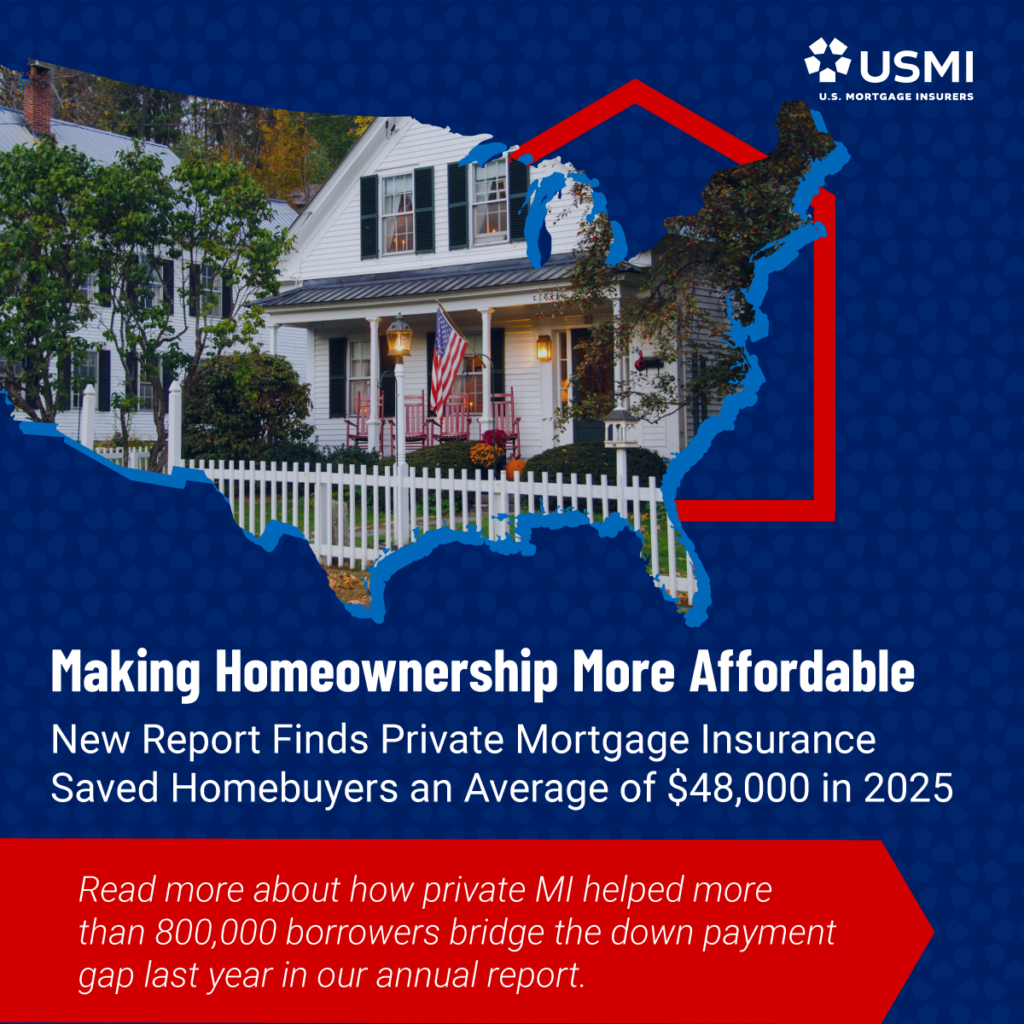
The benefits of private MI extend far beyond banks and taxpayers. In 2025 alone, more than 800,000 homebuyers across the country secured home financing with low down payments with the help of private MI. First-time buyers represented nearly 65% of purchase loans backed by private MI in 2025. Using private MI allowed these individuals to access homeownership sooner while retaining more of their savings, which can significantly help homeowners who may experience unexpected costs such as home repairs or temporary interruptions in income. What’s more, between 2020 and 2025, USMI estimates that using private mortgage insurance collectively saved American homebuyers more than $280 billion in cash due at the closing table, including more than $35.3 billion in 2025 alone. That’s more than a quarter-trillion dollars that homeowners collectively saved in down payment costs!
Always improving
Following the Global Financial Crisis, there were many regulatory and industry-led reforms to improve and strengthen the entire mortgage finance system. Enhancements to the private MI industry ensure that it can serve low down payment borrowers throughout all economic cycles and enable access to sustainable mortgage credit. In the years since the crisis, the private MI industry has paid out more than $62 billion in claims to the GSEs, lenders, and other investors.

Where do things stand?
Regulators did not finalize the 2023 proposal and have now proposed new regulatory capital requirements that are better calibrated to risk, recognize the uniqueness of the American housing finance market, and are less punitive to mortgage lending. These proposed rules are not yet finalized and banking regulators are currently reviewing comments received on the proposals.
More work to do
The March 2026 proposals represent a positive step forward and, with slight modifications, will support access to affordable mortgage financing for low down payment homebuyers through bank portfolio loans from lenders of all sizes, including community banks. USMI is asking regulators to explicitly recognize the risk mitigation that private MI provides when calculating regulatory capital, including by:
- Recognizing private MI coverage in the calculation of a mortgage’s loan-to-value (LTV) ratio for risk-weighting purposes, with capital relief calibrated to the depth of MI coverage.
- Applying a counterparty haircut to MI coverage consistent with FHFA’s framework for Fannie Mae and Freddie Mac.
- Recognizing mortgage insurers as “eligible guarantors” – the regulatory term for entities that can participate in bank credit risk transfer (CRT) transactions.
These actions would improve access to mortgage credit and make the American Dream of homeownership possible for more prospective homebuyers.
Other groups agree
USMI isn’t alone in this belief. Financial institutions and stakeholder groups, such as the Urban Institute, agree that recognizing private MI in the proposed bank capital rules is critical to serving creditworthy borrowers without access to large down payments. Dozens of commenters on the proposed rules advocated for recognizing private MI in calculating a mortgage’s LTV ratio for risk-weighting purposes; these included the National Association of REALTORS®, National Housing Conference, and Independent Community Bankers of America. Click here to see more of what they, and others, had to say.
USMI and its members stand ready to provide additional data and analysis to ensure that the regulators get this right. We look forward to working with the banking regulators and other market participants to make sure that first-time and working-class homebuyers can continue to access mortgage credit without a 20% down payment. If you are interested in learning more about how private MI protects lenders, the GSEs, investors and taxpayers against risk, click here.