


Homeownership: The Heart of the American Dream

As we commemorate America’s 250th birthday this year, it provides us the perfect opportunity to reflect on how homeownership has represented a cornerstone of the American Dream since the very beginning. Many things have changed since 1776, but this aspiration has remained constant and widely shared throughout generations.
Today, homeownership remains a goal that American families strive and save for and, with the help of private mortgage insurance (MI), millions of our fellow Americans have been able to achieve their own personal American Dream decades sooner.
The belief that homeownership is fundamental to the American experience is as old as the country itself. The founders drew from the writings of English philosopher John Locke, who believed in the fundamental rights of “life, liberty, and property,” to underpin the Declaration of Independence. Many people know Thomas Jefferson’s version better – “life, liberty, and the pursuit of happiness.” To the founders, however, these concepts were inextricably linked.
Throughout history, America’s leaders have reiterated how homeownership is a core part of the American identity. Their commitment to its role in the story of America has been both broad and bipartisan. “To possess one’s own home is the hope and ambition of almost every individual in our country,” said President Herbert Hoover. President John F. Kennedy, meanwhile, called homeownership “one of the noblest motives in the American way of life – it is inherent in the heart and soul of every American.” President Ronald Reagan believed that it is “an essential part of the American dream and fundamental to our way of life,” while President Bill Clinton said that “there is no more crucial building block for a strong community and a promising future than a solid home.”
The belief in homeownership and what it stands for in the American psyche transcends generations and ideologies. The desire to put down roots, build equity and generational wealth, and have a place to call your own is as salient today as it was 250 years ago. This is supported by respondents to USMI’s 2024 National Homeownership Market Survey, who noted that owning a home provides stability, a sense of safety, and is a good investment that provides financial security.
Despite this, a majority of Americans responding to the 2024 survey said it had become more difficult and challenging to purchase a home in the recent few years. The number was even higher for Americans who do not yet own their own home. One of the biggest challenges they reported is the ability to save for a 20% cash down payment plus closing costs. A 2025 USMI report found that it would take the average household earning the national median income approximately 26 years to save a 20% cash down payment plus closing costs at the median sales price for a home in America. For some families, that wait is even longer – particularly for first-time and working-class homebuyers.
This is where private MI makes a big difference, and where it has helped nearly 41 million people achieve homeownership sooner.
For nearly 70 years, private MI has made the dream of homeownership possible for millions of people across the country with down payments as low as just 3% of the home purchase price – allowing them to begin building generational wealth and equity years, or even decades, sooner.
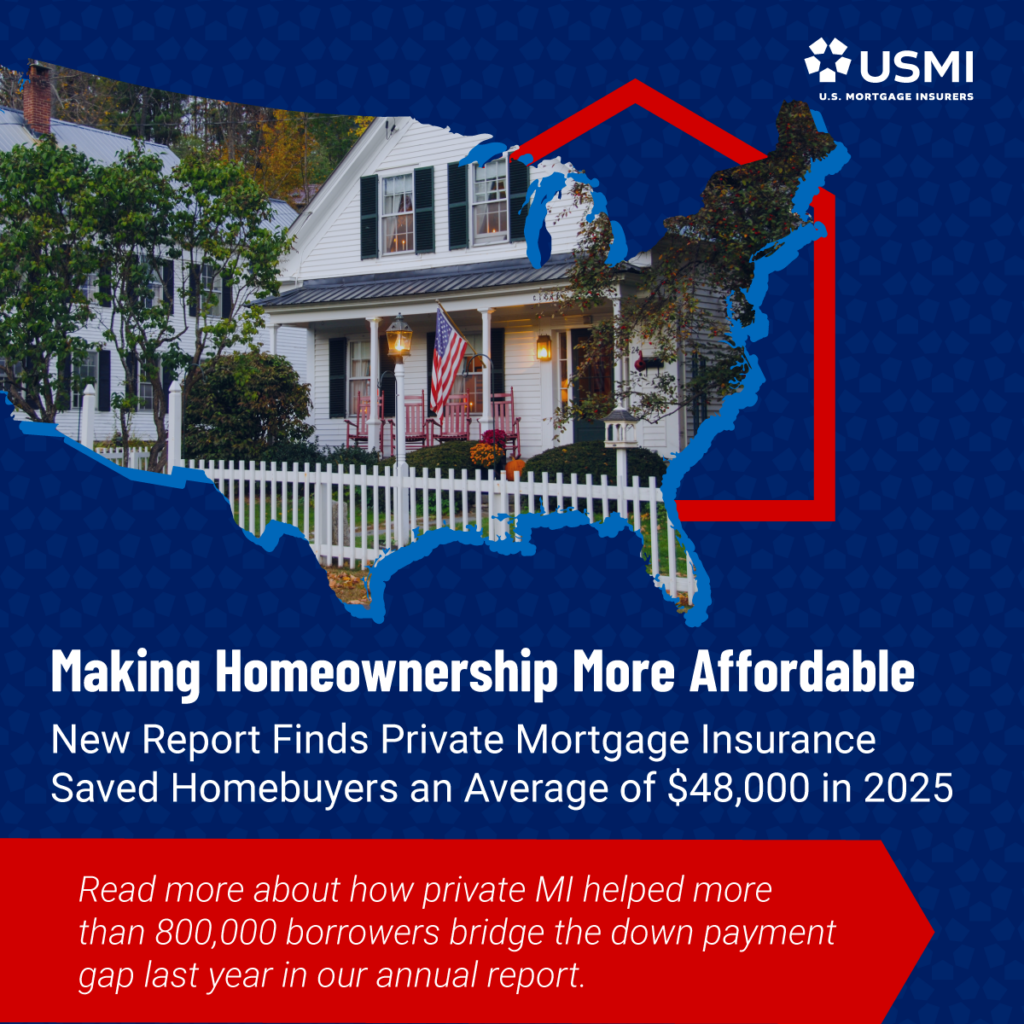
The numbers from last year alone underscore this point. In 2025, more than 800,000 homebuyers across the country secured home financing with low down payments with the help of private MI and nearly 65% of purchasers were first-time homebuyers. Using private MI allowed these individuals and families to access homeownership sooner while retaining more of their savings, significantly helping homeowners who might experience unexpected costs such as home repairs or temporary interruptions in income.
By enabling homeowners like these to get off the sidelines sooner with smaller down payments, private MI collectively saved American homebuyers more than $35.3 billion in down payment costs in 2025 alone. Since 2020, those savings have totaled more than $250 billion. That’s more than a quarter-trillion dollars that American homeowners collectively saved in down payment costs!
Importantly, while other costs associated with homeownership such as homeowners insurance premium rates and household utility rates have increased in recent years, private MI premium rates, as measured by publicly available in-force portfolio yield data, declined 25% since 2017. The increased use of granular dynamic pricing engines and the 2017 corporate tax rate cut from the Tax Cuts and Jobs Act have resulted in lower premiums for new homebuyers.
Private MI is also a temporary cost. Unlike MI premiums for most Federal Housing Administration (FHA) and other government-backed mortgages, private MI is temporary and automatically terminates when the loan-to-value (LTV) ratio reaches 78%, or can be cancelled earlier upon request in certain circumstances. This reduces the homeowner’s monthly mortgage payment and puts money back in his or her pocket.
And, thanks to the Working Families Tax Cuts signed into law by President Trump last summer, qualified homeowners will once again be able to deduct premiums paid to private MI companies and government agencies on their federal income taxes and receive targeted tax relief beginning with tax year 2026. In 2021, the last year this deduction was available to qualified homeowners, the average deduction was more than $2,300 per household. Starting next tax season, those savings return.
As we mark this milestone year for America, USMI is committed to ensuring that the American Dream of homeownership remains within reach for generations of Americans to come. If you are wondering how achieving that goal may work for you and how private MI can help, visit LowDownPaymentFacts.com.